
STM has released a video showing the launching of the third and final corvette for Royal Malaysian Navy, Tunku Osman Jewa. What I found mose intersting was the hull of the first National Fast Attack Craft (NFAC) prototype taking shape at İstanbul Denizcilik A.Ş. Shipyard — the first public look at the vessel’s physical construction since its keel-laying ceremony on 27 October.
The NFAC is intended to replace the Turkish Navy’s Doğan-class fast attack craft, in service since 1977–1988. Development began with a Phase 1 contract design agreement signed between the Presidency’s Secretariat of Defence Industries (SSB) and STM on 31 August 2020. Following the design phase, SSB and STM signed a follow-on contract on 9 September 2024 for construction of a single prototype vessel. First steel was cut on 8 July 2025, and the keel-laying ceremony followed on 27 October. STM first displayed a model of the design at IDEF 2025; a revised model was shown at Saha Expo 2026.
STM is the prototype’s main contractor, with construction under way at İstanbul Denizcilik A.Ş. Shipyard. The programme’s scope currently covers one prototype; a follow-on order for up to nine additional vessels — bringing the class to ten — would depend on the Navy’s evaluation of that vessel.
Design changes between IDEF 2025 and Saha Expo 2026:
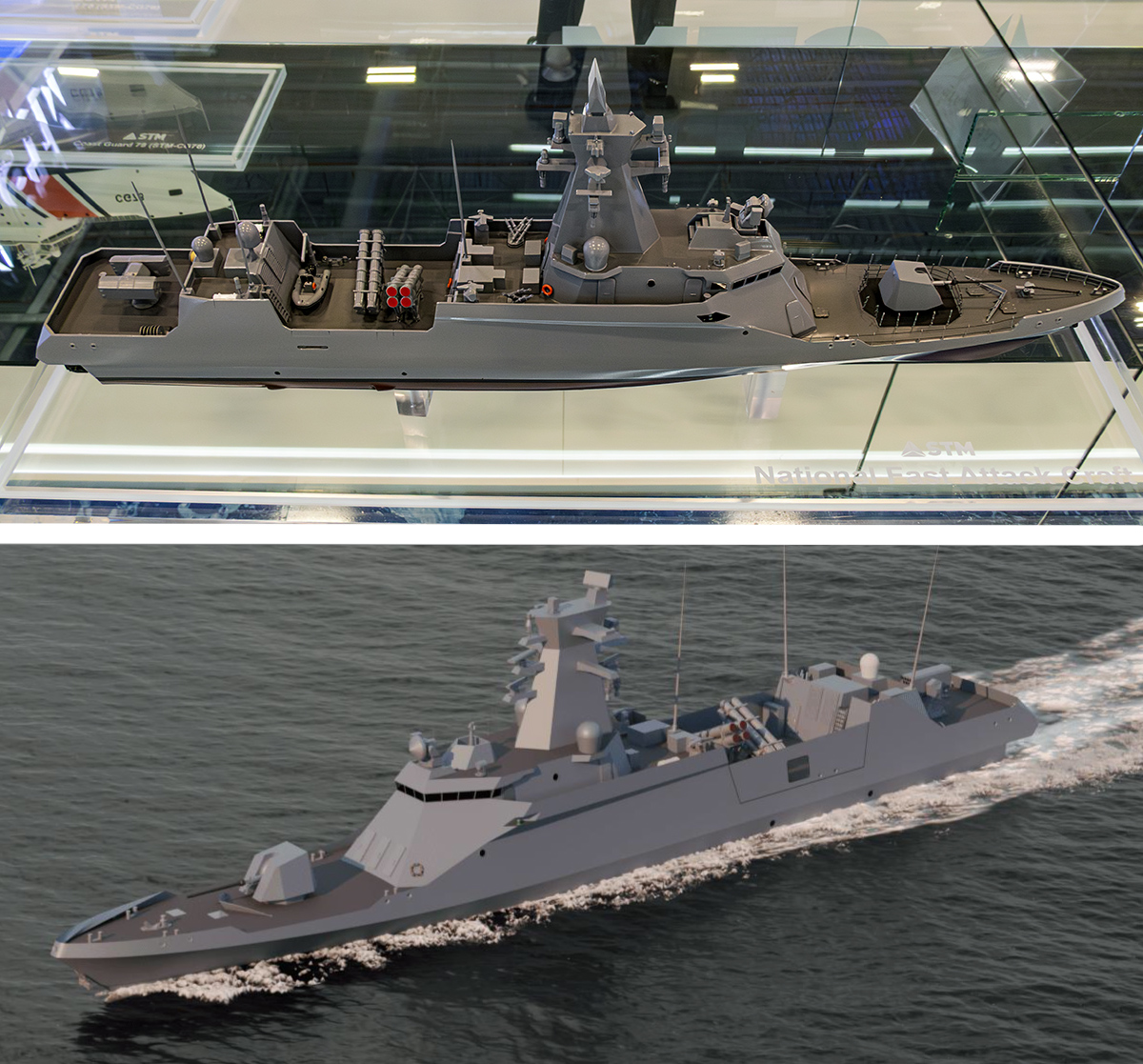
STM’s Saha Expo 2026 model showed several changes from the IDEF 2025 configuration, reflecting the design’s continued evolution ahead of the prototype’s completion:
- The Y-position point defence missile system is shown as Aselsan’s Göksur, fitted with a twin-arm launcher; four fixed-face phased array radars associated with Göksur now appear on the pilothouse roof.
- The Piri dual-band infrared search and track (IRST) system, previously mounted at the masthead alongside the main radar, has been relocated to the aft face of the mast — leaving only the main radar at the masthead.
- The Ahtapot electro-optic system has moved from an aft-facing position on the mast to a forward-facing one; a second, smaller electro-optic system — possibly Aselsan’s Kırlangıç — now faces aft.
- Decoy launchers have moved from the top of the aft superstructure to an amidships position forward of the mast.
- A new dome atop the aft superstructure, likely a SATCOM antenna, has been added.
Specifications:
The NFAC is designed for littoral surface warfare, prioritising speed, manoeuvrability and a reduced radar cross-section, with the ability to operate from concealed positions. The vessel is 68 metres long with a 9.34-metre beam and 2.5-metre draft, at an approximate displacement of 700 tonnes — roughly 17 percent longer and 60 percent heavier than the Doğan-class it replaces. Four diesel engines driving steerable waterjets, backed by three diesel generators, give a maximum speed exceeding 39 knots, a cruising speed of 20 knots, and a minimum range of 800 nautical miles. The ship carries a crew of 36 with a seven-day endurance.
Planned armament includes an MKE Denizhan 76mm main gun, eight Roketsan Atmaca anti-ship missiles, and a point defence missile system — Roketsan’s Levent and Aselsan’s Göksur have both been under consideration, though the Saha Expo 2026 model points to Göksur. Close-in defence is provided by two Aselsan STAMP-2 12.7mm remote weapon stations. Sensors include Aselsan’s Cenk 200-N 4D naval search radar, Akrep 300-N fire control radar, Ahtapot electro-optic system, Piri IRST, and Alper low-probability-of-intercept radar, alongside dual navigation radars and X-/Ka-band SATCOM. Havelsan’s ADVENT will serve as combat management system.
Why it matters
The NFAC is the first major Turkish Navy surface combatant designed outside the Navy’s own design process, unlike the ADA and İstif-class vessels. Whether the programme extends beyond the single prototype now under construction will depend on how the vessel performs in the Navy’s evaluation.


