
Türkiye has inducted its fourth T-70 utility helicopter into the Air Force Command in Combat Search and Rescue (CSAR) configuration, bringing the total number of aircraft delivered under the Turkish Utility Helicopter Programme (TUHP) to 31 across the armed forces and security agencies.
When Turkey launched its ambitious Turkish Utility Helicopter Programme (TUHP), the vision was bold.
In 2007, the Defence Industry Executive Committee approved the programme, which involved the joint production of a general-purpose helicopter with a maximum local content and subsystems, as well as production, testing, and delivery in Türkiye. The aim was to replicate the success of the Italian A-129 Mangusta’s transformation into the Turkish T-129 ATAK attack helicopter—this time in the utility role—and eventually create an export product.
Almost two decades later, the project remains incomplete, with only a few dozen helicopters delivered, and now faces an uncertain future. TUHP has become a case study in how shifts in geopolitics and warfare can ground even the most carefully planned defence projects.
Section 1 – The Backbone and the Need
The Turkish Armed Forces have long been a strong helicopter operator. In July 1974, the Turkish Land Forces airlifted a commando brigade to Cyprus using helicopters, supporting the unit until it linked up with forces arriving by sea.
Throughout the 1990s, the backbone of the Turkish Armed Forces’ utility helicopter fleet consisted of S-70A Black Hawk helicopters, procured to replace ageing UH-1 variants. These aircraft were used mainly in the southern and southeastern regions of Türkiye in counter-terrorism operations. They logged significant flight hours, often under fire and in “high and hot” conditions. Their replacement was therefore seen as a priority in the early 2000s. The TUHP was devised to introduce a new generation of aircraft tailored to Türkiye’s needs, with maximum local contribution.
Section 2 – The Promise
Following the ATAK attack helicopter project, TUHP was the next step in establishing a domestic helicopter industry. The ATAK is a localised version of the AgustaWestland A129 International attack helicopter, equipped with indigenous mission and weapon systems. TUHP was designed to further expand Türkiye’s helicopter manufacturing, development, and integration capabilities.
After a lengthy tender process and competition between the Sikorsky S-70i and AgustaWestland AW149, a contract was signed in February 2014 between TUSAŞ (Turkish Aerospace Industries) and the Undersecretariat for Defence Industries for a localized version of the S-70i. Sikorsky’s license covered the production of up to 600 helicopters for both domestic use and export over a 30-year period. Sikorsky was obliged to conduct co-production with Turkish industry for the T-70 helicopters, as well as provide Turkish goods and services under offset arrangements, including future exports of helicopters built in Türkiye.
Section 3 – The Helicopter
The T-70 is essentially a Turkish version of the S-70i Black Hawk, the latest export variant of the Black Hawk family. It is powered by twin T700-TEI-701D turboshaft engines—Turkish-produced versions of the T700—manufactured under license by TUSAŞ Engine Industries (TEI). Its avionics suite was developed by ASELSAN, including the mission computer, color multifunction displays (MFDs), the SKYMAP digital moving map, and an indigenous IFF Mod 5/C responder. Another major contractor, Alp Aviation, produces the main rotor heads, transmissions, and intermediate and tail rotor gearboxes.
Section 4 – The Difficult Take-Off
The first S-70i, prototype for the future T-70, was delivered to TUSAŞ from Sikorsky’s PZL Mielec plant in Poland in June 2016, two years after the contract was signed. It then took another three years for the Turkish defence industry to complete its share of development and production work. The prototype was finished for testing in November 2019, and the first T-70 flight took place on 28 October 2021—14 years after project launch and seven years after contract signature.
Assoc. Prof. Sıtkı Egeli from Izmir University of Economics identifies two key factors behind the delays. First, the rapid rise of armed unmanned aerial vehicles (UAVs) in Turkish operations—whether counter-terrorism missions or cross-border operations such as Euphrates Shield and Olive Branch—reduced the demand for helicopter-borne troops. UCAVs could stay aloft longer, see further, and strike targets immediately, lessening the need to insert light infantry by helicopter in mountainous terrain. This shift in operational requirements directly affected the number and types of helicopters requested by the armed forces during the project.
Ultimately, the 109 helicopters to be procured were finalised as:
-
- Land Forces Command (KKK): 36 T-70 (General Purpose)
- Air Force Command (HvKK): 6 T-70 (Combat Search and Rescue)
- Gendarmerie (JGK): 33 T-70 (General Purpose)
- Special Forces (ÖKK): 11 T-70 (CSAR)
- Police (EGM): 20 T-70 (General Purpose)
- Directorate of Forestry (OGM): 3 T-70 (Firefighting/General Purpose)
A second factor was the deterioration of U.S.–Turkish relations. Tensions began after the failed coup attempt in 2016 and peaked with Türkiye’s purchase of the Russian S-400 air defence system, which led to U.S. sanctions under CAATSA.
Lockheed Martin’s 2024 annual report, published in early 2025, highlighted the impact:
“In 2020, the U.S. Government imposed certain sanctions on Turkish entities and persons that have affected our ability to perform under the TUHP contracts, and we have provided force majeure notices under the affected contracts. We partially stopped work on TUHP effective October 5, 2024. We are currently in discussions with our customer regarding the path forward…”
During its July 2025 earnings call, Lockheed Martin executives revealed a notional agreement to restructure the programme, acknowledging a $95 million loss related to the sanctions. The company noted that sanctions had directly impaired its ability to perform under TUHP, and that discussions with the customer were ongoing. At IDEF 2025, Lockheed Martin declined to comment further.
Another contributing factor was the prolonged bureaucratic process within the U.S. government and military to review and approve the technology transfer details under the Sikorsky–TUSAŞ contract, further delaying progress.
Section 5 – The Alternative
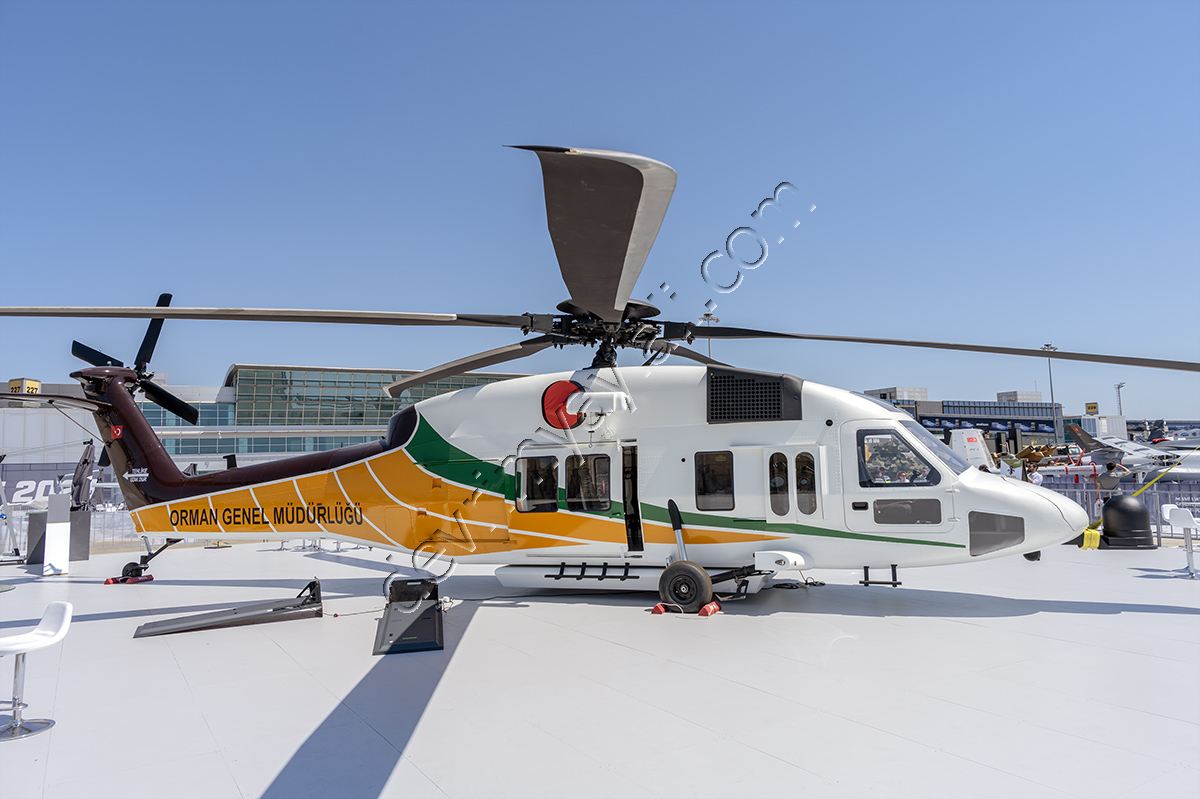
Even though the Turkish Armed Forces’ need for utility helicopters have diminished and the cooperation with the US government and corporations has been hindered the Turkey’s need for utility helicopters is not over, and another project has started to hatch.
Building on experience from the T129 ATAK and the T625 Gökbey programs, Turkish Aerospace is developing the T925 Heavy Utility Helicopter. The aircraft is designed to provide greater capacity than the T625 and address operational requirements in both civilian and military roles.
The twin-engine T925 will have a maximum take-off weight of around 12,000 kg, accommodating a crew of two and up to 19 passengers. It is expected to achieve a maximum cruise speed of 175 knots, an endurance of approximately three hours, and operations at altitudes up to 20,000 feet. In firefighting configuration, the helicopter will be capable of carrying 4 tons of water.
The prototype is scheduled to make its first flight in 2026, with entry into service with the General Directorate of Forestry planned from 2028. Powered by two Ukrainian Motor Sich TV3-117VMA-SBM1V turboshaft engines, the platform is intended to operate effectively in “hot and high” conditions.
Planned mission sets include troop and cargo transport, search and rescue, offshore operations, firefighting, air ambulance, and VIP transport. Design features incorporate modern avionics, a large cabin area, rotor ice protection, and options such as cargo hook, rescue hoist, and automatic blade and tail folding for naval use.
Section 6 – Conclusion
Utility helicopters may no longer capture headlines like fighter jets or drones, but they remain essential. They move troops, evacuate wounded soldiers, fight wildfires, and deliver disaster relief—missions UAVs cannot easily replace.
For Türkiye, the stalled TUHP is both a cautionary tale and a turning point. It highlights the limits of relying on foreign partners in a volatile political climate, while also underscoring the risks of pursuing complete independence without sufficient support.
The programme is still alive, but its original promise has faded. Now the future rests on the T925. If it succeeds, Türkiye could finally achieve the helicopter self-sufficiency it once sought. If not, the Black Hawk’s shadow may linger for years to come.


