
The Qatar Emiri Naval Forces’ landing platform dock (LPD) Al Fulk is currently in Istanbul, where it arrived on 16 August for a port visit that will continue until 21 August. The stop offers Turkish naval observers a chance to see firsthand one of the most unusual and ambitious ship designs to emerge in recent years. Built by Fincantieri at its Palermo and Muggiano yards, Al Fulk is more than a conventional amphibious ship—it represents a bold and creative solution to Qatar’s specific naval requirements.
Launched in January 2023, Al Fulk was constructed to RINAMIL standards for naval vessels, ensuring high performance across air, sea, and land operations. The ship measures 143 meters in length and 21.5 meters in beam, with a displacement of 8,800 tons. It can carry up to 440 embarked troops in addition to a crew of 150, and its internal spaces include a floodable dock for landing craft and a large garage with two ramps for vehicles.
On its flight deck, the LPD can host up to three NH90 helicopters, supported by a hangar and aviation facilities. These features enable the vessel to perform a wide range of roles, including humanitarian assistance and disaster relief, amphibious operations, and support for ground forces.
What sets Al Fulk apart from other amphibious ships is its extensive air defense suite. The vessel has been fitted with a capability rarely—if ever—seen on LPDs: a system designed to complement Qatar’s Al Zubarah-class air defense corvettes by sharing a long-range air picture.
The ship’s sensors include the Leonardo Kronos multifunction AESA radar and the Kronos Power Shield L-band radar, the latter too large to be installed on the corvettes. This arrangement enables the LPD to serve as a powerful sensor node for the entire fleet.
To match these detection systems, Al Fulk carries two 8-cell Sylver A50 vertical launch systems (VLS) armed with MBDA Aster 15 and Aster 30 Block 1 missiles as part of the SAAM-ESD air-defense system. Combined with the Kronos radar suite, this gives the vessel a tactical ballistic missile defense capability, comparable to the ground-based SAMP/T system but with extended reach at sea.
Additional defensive systems include the Lacroix Sylena Mk2 decoy launchers, a 76 mm OTO Melara Super Rapido gun, and four 30 mm Marlin WS guns.
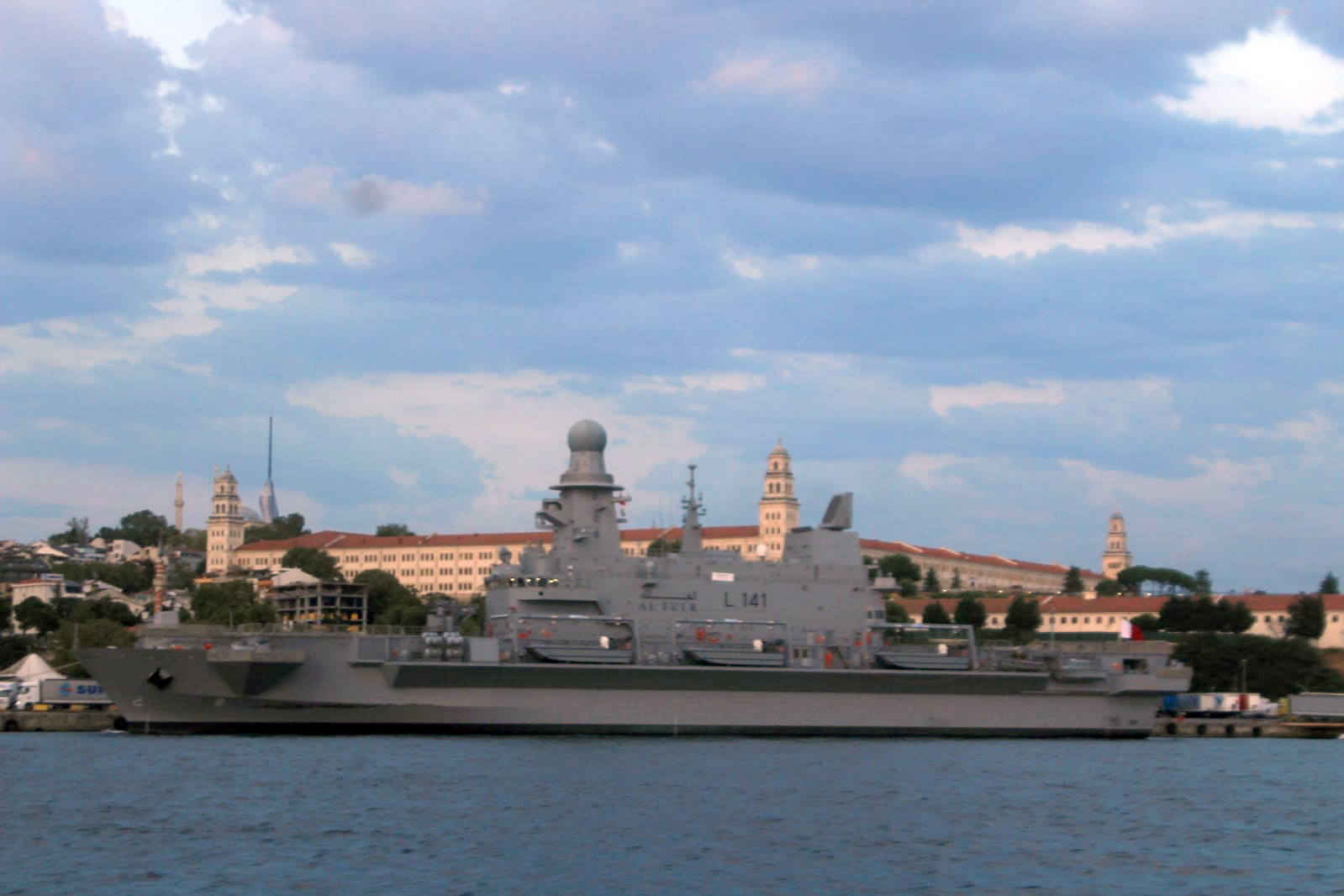
Al Fulk displaces 8,800 tons and measures 142.9 meters overall, with a beam of 21.5 meters and a draught of 5.3 meters. Propulsion is provided by two Wärtsilä 12V32 diesel engines generating 12,000 kW, giving the vessel a top speed of 20 knots. It has a range of 7,000 nautical miles at 15 knots, making it capable of extended deployments.

The ship accommodates a complement of 150 crew members along with 440 embarked troops.
For many small navies with limited budgets, creativity is often the only path to capability. In Qatar’s case, the budget is not constrained—but manpower is. The Qatari fleet cannot crew a large number of specialized vessels, so its planners sought a multi-purpose platform that could combine several missions in one hull.
Small navies such as those of Denmark, Belgium, or Qatar face a common challenge: unlike major maritime powers, they cannot afford to operate large numbers of specialized ships, each dedicated to a single role. Instead, they are often forced to innovate—designing multi-purpose platforms that combine capabilities traditionally spread across several classes of vessels.
Denmark’s Absalon-class vessels blend command, support, and combat functions in one hull; Belgium is pushing hard into joint programs and unmanned systems to extend its reach; and Qatar’s new LPD Al Fulk merges amphibious operations with ballistic missile defense.
Al Fulk is precisely that: a jack of many trades, blending amphibious capabilities with a high-end air defense role. Whether this unusual mixture proves successful in practice remains to be seen, but the concept itself is an innovative response to Qatar’s unique requirements.
With its blend of amphibious lift, helicopter facilities, and advanced air defense systems, Al Fulk stands out as a naval experiment without a direct equivalent. As the ship spends the week in Istanbul, it is drawing attention not only for its size and firepower, but also for what it represents: a small navy’s attempt to stretch limited manpower into maximum capability through an unusually versatile warship.

 devrimyaylali.com