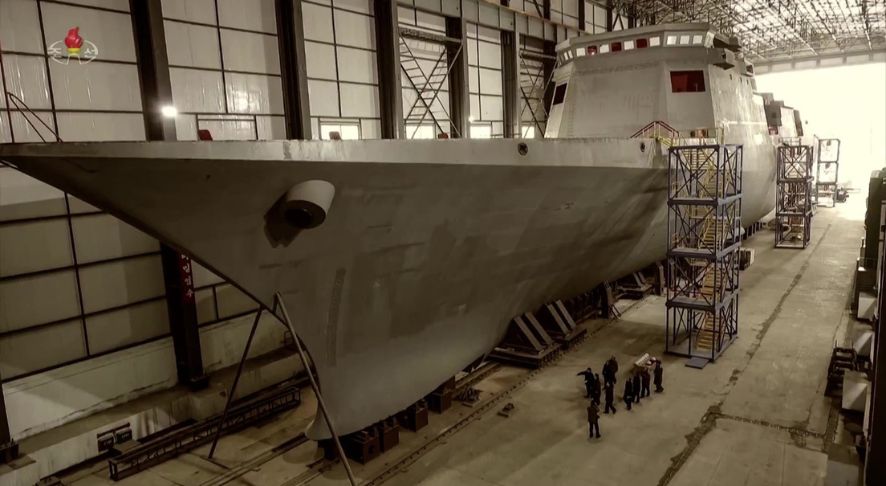
On 10 January 2025, Joseph H. Dempsey published a detailed analysis on the IISS Military Balance Blog, shedding light on North Korea’s latest naval development. Dempsey’s report highlights the construction of the country’s largest-ever warship, providing key insights into its design, potential capabilities, and strategic implications. This development aligns with the IISS’s earlier assessment, confirming the rapid evolution of North Korea’s naval projects despite significant operational and technological challenges.
North Korean state media recently revealed images confirming the construction of the country’s largest warship to date at the Nampo shipyard. This supports an October 2024 analysis by the IISS. The vessel is estimated to exceed 120 meters in length, a significant leap from North Korea’s typically smaller naval fleet. The ship appears designed to imitate modern warships, with features suggesting the potential inclusion of a vertical launch system (VLS), although questions remain regarding its armament and operational role. North Korea’s navy primarily comprises smaller, aging vessels, raising doubts about the strategic utility of this new combatant. Observers speculate its purpose may lean more toward propaganda and prestige than effective blue-water capabilities, especially given limitations in advanced technology and external dependencies. Despite these uncertainties, the ship’s construction signals a notable step in North Korea’s naval ambitions.
Dempsey’s analysis underscores both the potential and the ambiguities surrounding this ambitious naval project. While the vessel’s design hints at efforts to modernize North Korea’s fleet, it also raises questions about the country’s ability to integrate advanced systems effectively. This context provides an interesting lens to consider North Korea’s broader naval strategy and its implications for regional security. Below, I share my observations based on the information and images shared by IISS:
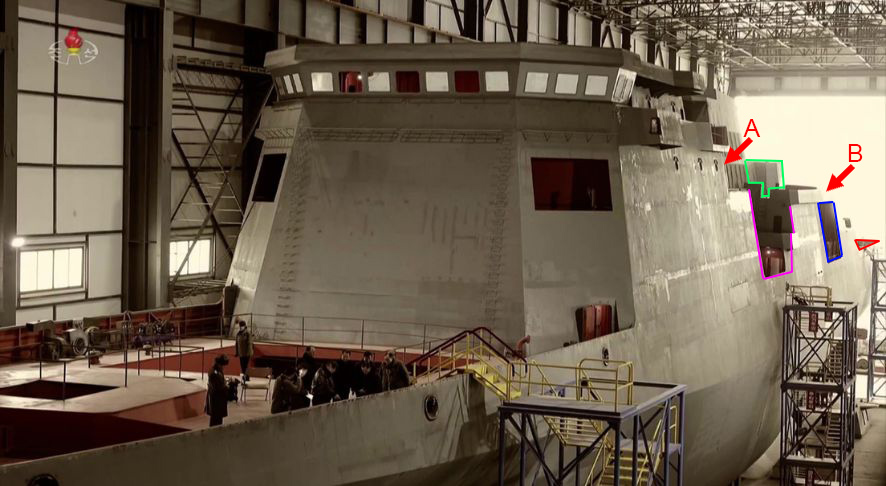
The two large rectangles facing the bow of the ship, just below the bridge, appear to be potential installation points for static radar arrays. To achieve 360-degree radar coverage, two additional modules would likely be needed to cover the ship’s rear. Potential locations for these aft-facing arrays are marked with red arrows.
If North Korea is attempting to replicate radar configurations seen on ships like the Arleigh Burke-class destroyers, the most likely location for the aft-facing arrays is marked as “A.” This spot is at a similar height to the forward-looking arrays and is situated within the main superstructure, which would simplify wiring and structural integration.
Alternatively, if the North Korean design is inspired by Japan’s Akizuki-class destroyers, which position radar modules further aft on the superstructure, the location marked “B” becomes a plausible option.
The ship’s design features appear modern, with stealth characteristics evident in its sloped surfaces and enclosed structures. The blue rectangle on the superstructure is likely the housing for davits and service boats. Enclosing this area would help reduce radar returns, a design feature commonly seen on modern stealth warships since the La Fayette class of the early 1990s.
The green section seems to indicate the top of a hangar, while the red triangle could represent a helicopter landing pad. If this ship is equipped with both a hangar and a landing pad, it would mark the first time North Korea has included such features on a surface combatant. However, it remains unclear if North Korea possesses the operational capability, including helicopters and relevant infrastructure, to utilize these facilities effectively.
The area between the hangar and the davits bay appears suitable for the installation of close-in weapon systems (CIWS). This positioning would provide coverage for the ship’s midsection and potentially its rear.
The purple section amidships likely houses anti-ship missiles, and it is plausible that this area could be covered in the future to maintain clean design lines and reduce radar signatures. according to IISS, the Kumsong-3 (KN-SS-N-2 Stormpetrel) long-range anti-ship missile or a related variant, or potentially the Hwasal-2 land-attack cruise missile might be installed on board. As both missiles have only been observed slant launched, so they likely be mounted here.
The funnel design includes visible inlets that might suggest a gas turbine propulsion system. While this is a possibility, North Korea’s known limitations in accessing advanced gas turbine technology suggest that alternative propulsion systems, such as diesel engines, might be more likely. Future imagery or reports would provide better clarity.]
In conclusion, while the ship demonstrates an effort to incorporate modern features, including stealth elements and advanced radar configurations, many aspects of its design remain speculative due to limited information. Additional analysis and observation will be necessary to validate these assumptions as construction progresses.

 devrimyaylali.com