Turkey’s exploration of small manned submarines represents the second key area of its underwater projects. These submarines, while compact, provide strategic versatility in tasks ranging from tactical warfare to special operations, supporting Turkey’s broader submarine development ambitions.
The Turkish Navy has pursued two prominent projects in the small manned submarine category: the multipurpose mini-submarine MPMS and the STM-500, each designed for different operational scopes but collectively support Turkey’s defense technology base, potentially contributing to larger submarine designs in the future, such as MILDEN.
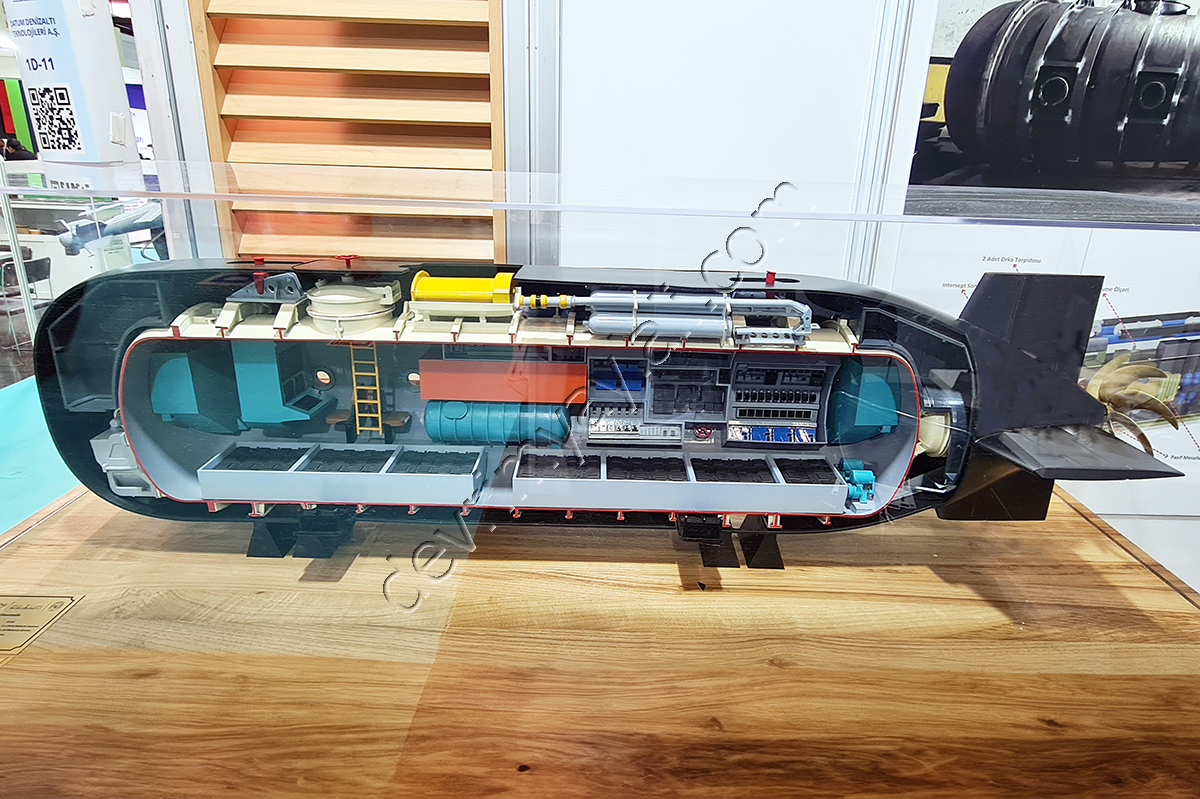
The first project is a multipurpose mini-submarine developed by Datum Submarine Engineering Inc., a subsidiary of Istanbul Technical University, and Sefine Shipyard. Known as the MPMS, this project began as a Technology Development Project commissioned by the SSB as part of the DİMDEG initiative. Upon completion, the MPMS will be 12 meters long, 2.3 meters wide, and 2.9 meters high, with a displacement of approximately 36 tons and a diving depth of 280 meters. It will have a crew of four. According to Datum Chairman Assist. Prof. Dr. Münir Cansın Özden, the submarine features a seven-blade propeller and a hydraulically controlled cross-shaped steering system, as well as systems for diving, trim, and cistern adjustments, pumps, compressed air circuits, and various sensors for monitoring pressure, gas, levels, and fire detection.
The MPMS will include forward-looking sonar, altimeter, and radar systems, as well as a specially designed inertial navigation system that incorporates GPS and a Doppler speedometer. Two collapsible masts will house communication and navigation antennas, and a 360-degree electro-optical camera will provide a full-view capability. The MPMS is powered by a water-cooled electric motor developed by Femsan DC Motor. Harbor acceptance tests are expected to begin by late 2024.
Once operational, the MPMS will primarily test new weapons, sensor systems, and other equipment developed by Turkish defense companies for the MILDEN project. Datum also has a range of other manned mini-submarines in development, including the Trança multi-purpose mini attack submarine, the Gurnard deep-diving wet & dry seabad warfare submarine, and the Datum dry combat submarine, as well as a submarine rescue vehicle.
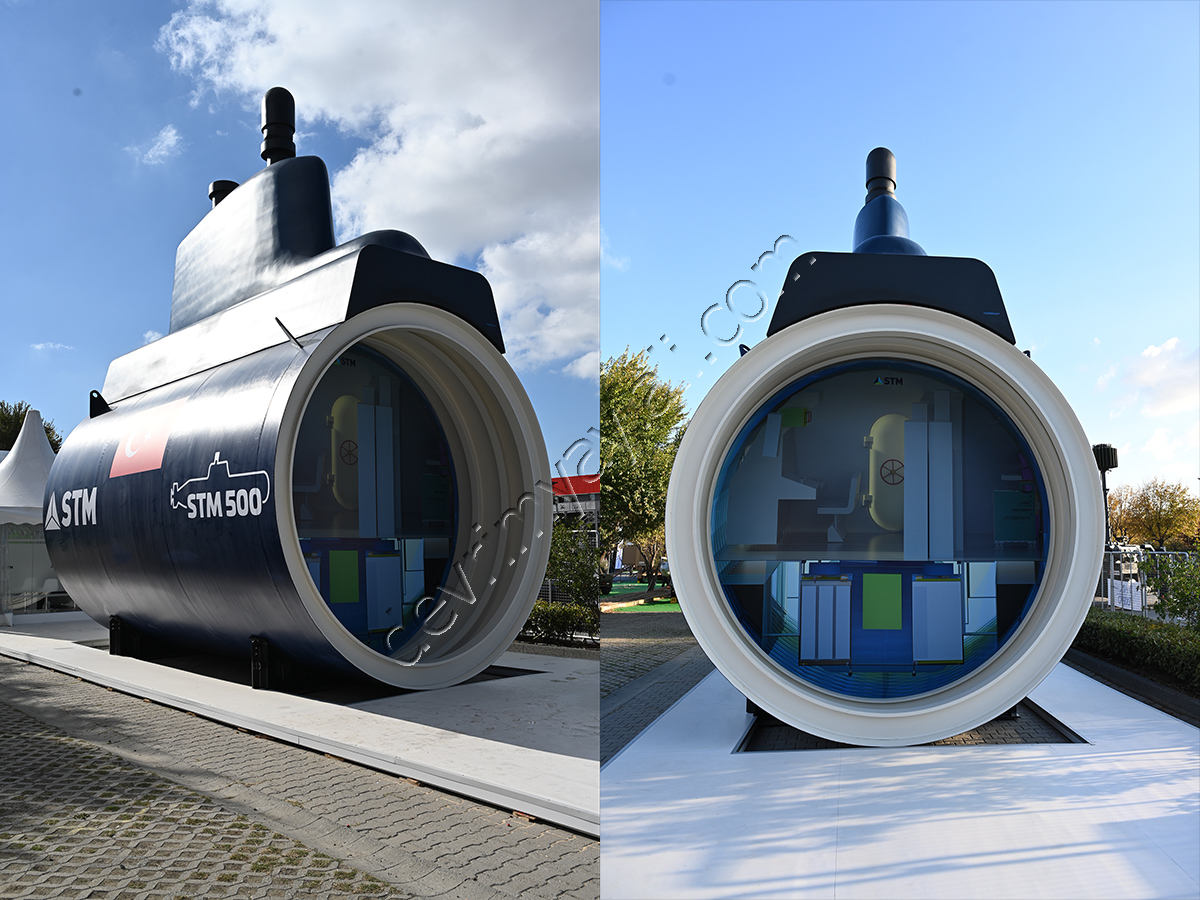
The second medium sized manned submarine project is the larger STM-500, marketed by STM. During the Saha Expo, STM exhibited a 5-meter section of the STM-500’s pressure hull, manufactured by Tekfen Engineering, marking the first partnership between a naval design company and a Turkish civilian steel manufacturer. STM, which claims to be the only civilian company in Turkey with the capability to design and build manned submarines, designed the STM-500 for global tactical missions, including reconnaissance, surveillance, special forces operations, and anti-submarine warfare.
The STM-500 project is mainly funded by STM itself, as it currently lacks a committed customer, highlighting the challenges of financing defense projects without confirmed clients. Capable of 30-day operations at depths exceeding 200 meters, the STM-500 can carry a crew of 22 and an 8-member special forces team. It will feature four torpedo tubes with a total capacity of eight torpedoes and guided missiles. Measuring 49 meters long with a 4.6-meter diameter, it displaces 700 tons when submerged. The STM-500 has a maximum submerged speed of 18 knots and a transit speed of 5 knots. With an Air-Independent Propulsion (AIP) system, it could operate underwater for extended periods without surfacing.
As Turkey’s smaller manned submarine projects move forward, they lay the groundwork for the nation’s larger ambition: the MILDEN project. In the final section, we delve into MILDEN, Turkey’s flagship indigenous submarine program, which embodies the vision of achieving complete self-sufficiency and bolstering operational flexibility


