Turkey’s ambitious submarine development program underscores its commitment to achieving naval self-sufficiency and advancing technological expertise. This multi-tiered strategy encompasses autonomous systems, small manned submarines, and the indigenous MILDEN submarine project, each with a distinct purpose and targeted capabilities. As Turkey builds upon its defense and maritime industry, these initiatives illustrate the drive toward greater independence in underwater technology and the potential to become a global player in maritime defense systems.
The primary objective of Turkey’s submarine projects is to design and build an indigenous submarine for the Turkish Navy, ultimately advancing Turkey’s strategic self-reliance and technological capabilities. By creating an independent defense industry, Turkey aims to reduce reliance on foreign suppliers, gain flexibility in operational capabilities, and develop customized solutions for regional and international defense needs. Toward this end, the Navy has established a design office and initiated the development of the National Submarine, known as Milli Denizaltı (MILDEN).
To achieve this ambitious goal and ensure true self-sufficiency in underwater technology, Turkey must master a range of critical technological domains, including propulsion, sonar imaging, and autonomous operations. Currently, there are three distinct, parallel pathways in Turkey’s underwater project strategy, each contributing to a phased development of Turkish expertise in this field.
The first pathway is unmanned autonomous systems. During the Saha Expo held in Istanbul from October 22 to 26, STM unveiled their NETA-300 and NETA-1000 devices, adding to Aselsan’s Deringöz device. These devices are primarily designed for mine countermeasure operations, aiming to gradually replace foreign-made systems like the Teledyne Gavia currently in use, while building domestic expertise in underwater technology. The objective is clear: the Turkish Navy already uses four Teledyne Gavia systems, and the goal is to replace these with Turkish-made devices, streamlining supply and procurement processes. The goal is phased, with initial steps relying on existing foreign technology while Turkey builds its domestic capabilities.

The NETA 300, the first in its family, is compact, flexible, and modular. It can be carried by two people and operates at depths of up to 300 meters. With a maximum speed of 5 knots, it can function autonomously for up to 24 hours on a single battery charge, using side-scan and gap-filling sonar technologies to identify mines in high-risk areas. Synthetic aperture sonar (SAS) further enhances its scan area and resolution. STM NETA 300 is deployable from any surface platform and can support search and rescue (SAR) operations through wide-area scans. Its side-scan sonar and precision navigation systems provide accurate data for target and wreck detection. With a maximum length of 2.7 meters and a diameter of 20.5 centimetres, NETA 300 weighs between 70 to 85 kg, depending on the configuration.
For clarity, civilian applications include seabed and environmental assessments, pipeline inspections, geophysical surveys, offshore renewable energy exploration, and marine archaeology, expanding its use beyond military operations. STM officials at the Saha Expo indicated that the NETA 300 would likely enter testing in 2024. STM is also developing a larger unmanned underwater vehicle (UUV), the NETA 1000, which is 5.4 meters long, has a 32.4-centimeter diameter and weighs up to 360 kilograms. The NETA 1000 has a maximum speed of 8 knots and an operational capacity of up to 32 hours with a SAS payload.
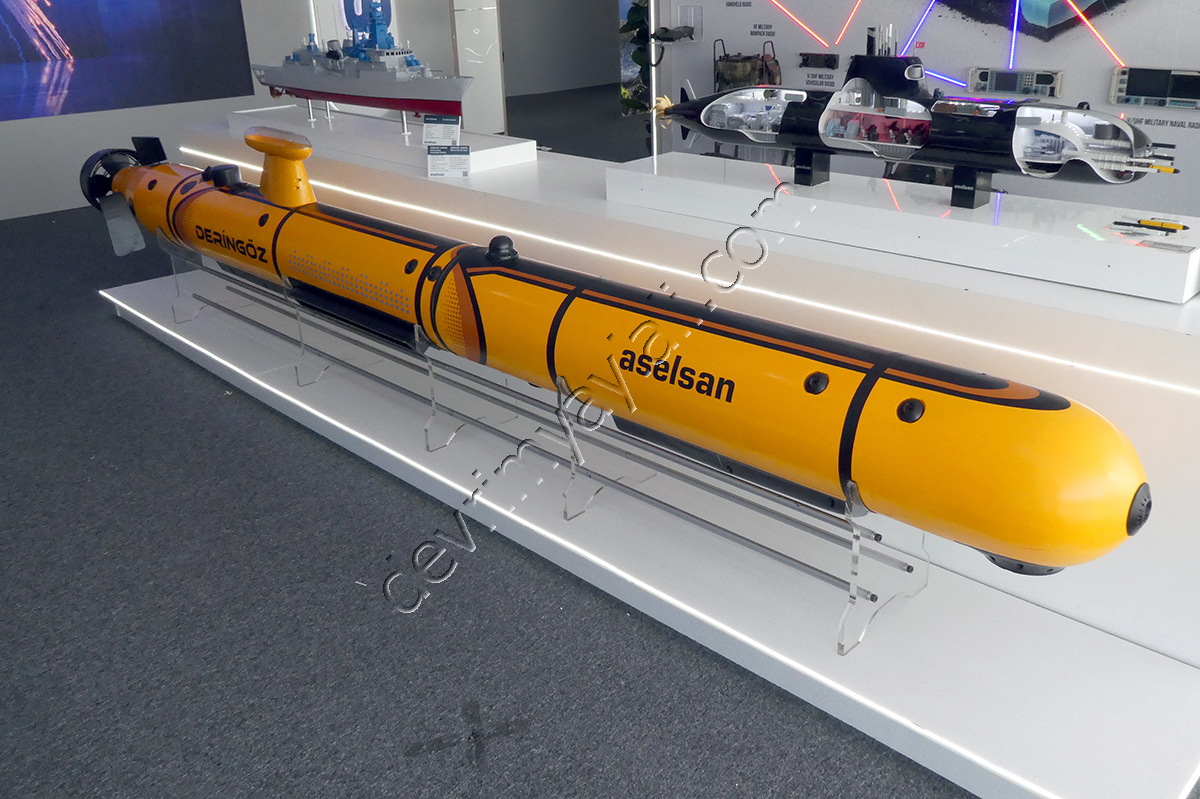
STM’s devices compete with Aselsan’s Deringöz, another UUV in this category. According to Aselsan, Deringöz dive tests were conducted in March 2024. Designed for both military and civilian purposes, Deringöz has autonomous capabilities, modular architecture, and payload configurations that can be adjusted based on requirements. It reaches a maximum speed of 5.5 knots and operates at depths of up to 600 meters. Deringöz’s features include high manoeuvrability, precise navigation, customizable payloads, optical and sonar imaging technologies, and wireless communication infrastructure, making it suitable for underwater research, reconnaissance, surveillance, mine detection, pipeline inspection, and port and base protection. It can operate for up to 15 hours.
While the market for such devices is expanding, confirmed evidence of export interest could further validate demand. Turkey’s new minehunter project will likely create a strong entry market, and both companies could also see export opportunities.
Turkey’s push into unmanned systems reflects a growing need to reduce dependency on foreign manufacturers and develop national expertise in mine countermeasures and reconnaissance. In the next section, we explore Turkey’s venture into small manned submarines, a complementary avenue that aims to support advanced tactical operations in restricted waters.

 devrimyaylali.com