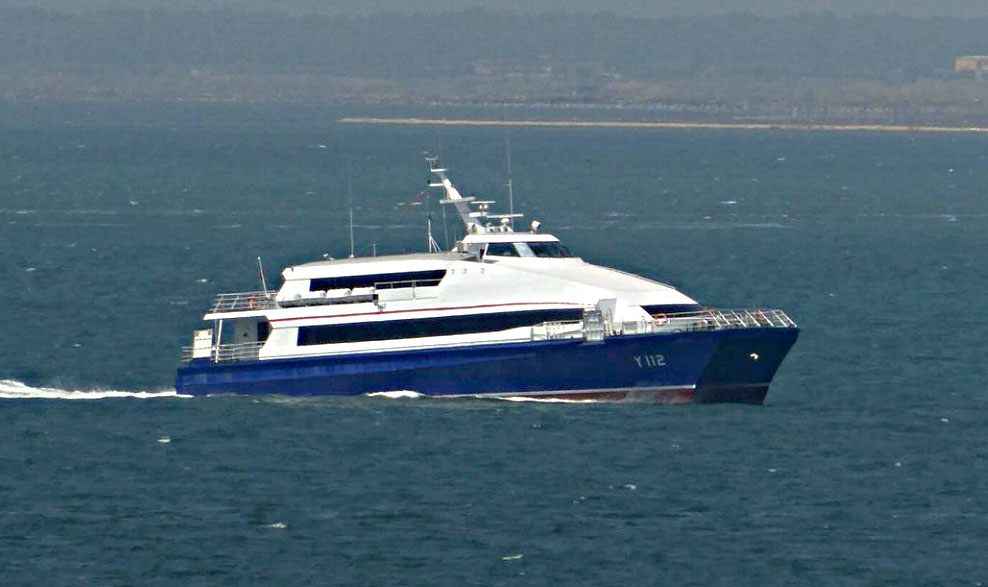
İstanbul Deniz Otobüsleri A.Ş. (İDO) was founded by the Municipality of Istanbul in 1987 as an alternative to Şehir Hatları, a state company that provided sea-borne transportation in Istanbul and other cities such as Çanakkale, İzmir, and İzmit. The aim of the company was to provide sea transportation using catamaran-type fast boats and ferries. In 2011, the company was privatized and sold to a consortium of Turkish companies.
The company expanded by adding lucrative car ferries to its fleet and began hauling vehicles across the Marmara Sea. These routes were in high demand, especially in summer for holidaymakers.
These large car ferries played an important role in 2011 when Turkey was forced to evacuate 23,127 civilians from Libya after the fall of the Gaddafi regime. 8,351 civilians were transported by naval vessels and civilian ferries. Two long-range ferries from İDO, M/V Osman Gazi and M/V Orhan Gazi, played a crucial role during this event as they ferried between Turkey and Libya constantly during the crisis.
These two Austal-built vessels can carry 1,200 passengers and 225 cars, or 126 lane meters and 158 cars for vehicles with a speed of up to 37 knots.
The construction of the Osmangazi Bridge across the Gulf of İzmit and the Çanakkale 1915 Bridge across the Çanakkale Strait had a profound adverse effect on İDO’s business, as these bridges made travel to and from Istanbul less dependent on sea routes. As a private company with responsibilities to its shareholders, İDO was forced to close some of the less profitable routes and sell some of its vessels.
Thus, the two largest fast ferries under the Turkish flag, M/V Osman Gazi and M/V Orhan Gaz, were bought by the Greek company Seajets and are now in Greece.
Three of the smaller passenger-carrying fast catamaran-type vessels of İDO, M/V Seydi Ali Reis-1, M/V Kaptan Paşa, and M/V Oruç Reis-5, were bought by the Turkish Navy and are undergoing overhauls at Alaybey Naval Shipyard in İzmir.
While I understand the financial concerns forcing İDO to sell its ferries, the operation of these ferries is not just a commercial concern. They were, more or less, part of Turkey’s overall sea lift capability and vital elements of Turkey’s civilian fleet. The sale of İDO’s strategic vessels, particularly the M/V Osman Gazi and M/V Orhan Gazi, to a Greek company, and the transfer of smaller fast catamaran vessels to the Turkish Navy, highlights a deeper concern beyond financial considerations. These vessels were not merely commercial assets but also vital elements of Turkey’s sea lift capability and civilian fleet.
If we were forced to conduct a large-scale non-combatant evacuation operation now or in the future, we would have less capacity to conduct such an operation. One can argue that the commissioning of the large amphibious ship TCG Anadolu can compensate for the loss of the civilian vessels. However, TCG Anadolu can only be in one place at a time, and the more diverse tools you have in your inventory, the more flexible your operations can be.
The loss of İDO’s vessels underscores Turkey’s sea blindness, revealing a strategic vulnerability that must be addressed.

 devrimyaylali.com