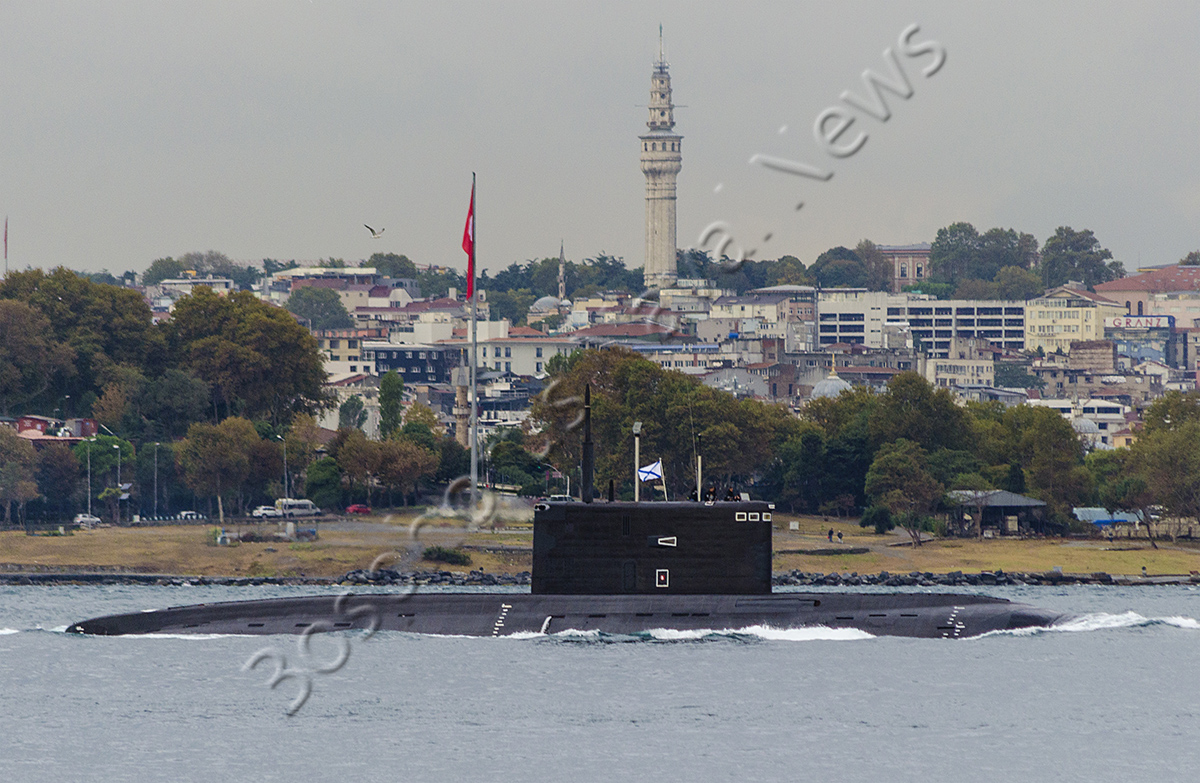
In this last instalment of my, week-long exploration of the significant naval developments that shaped the maritime landscape from my point of view in 2023, I must confess that little did I imagine back in 2022 that the Russians would tragically lose a submarine to a nation without ASW capabilities in 2023.
The vast and dark oceans provide the perfect cover for the submarines. They hide under the surface and move freely. Most of the time their existence is noticed when a ship explodes by a torpedo hit.
The submarines are most vulnerable when they cannot use the depth and the vastness of the oceans to cover. Therefore, the Ukrainian Armed Forces with no means of conducting anti-submarine warfare were able to destroy the submarine Rostov-na-donu when it was most vulnerable to enemy action. She was sitting high and dry inside a drydock.
According to my knowledge, she was the third submarine to be lost in combat since World War 2. The first one was PNS Ghazi lost during the 1971 Indo-Pakistan War. It was a Tench-class diesel-electric submarine, that lost all hands operating off the Visakhapatnam harbour. The second one was ARA Santa Fe a Balao-class submarine.
The loss of Rostov-na-Donu was particularly hard on the Russian Black Sea Fleet as she was one of the few remaining units that were capable of firing long-ranged Kaliber cruise missiles at Ukrainian targets deep inside the country without being harrrased or threatened by the Ukrainian anti-ship missiles or unmanned expendable surface vessels. Let us take a closer look at the Kilo/improved Kilo-class submarines:
Initially, Project 636 was intended only for the Soviet Navy, but since 1993, these submarines have been available to foreign users. Project 636 is also known as the Improved Kilo Class since the design of the vessels is based on Project 877. However, the differences are significant. In order to further quiet this particular submarine, the bow was reshaped, and some auxiliary machinery was moved to the aft of the submarine. Furthermore, these vessels are covered with anechoic tiles on the outer hull. Because of their quietness, these submarines have been marketed as “Black Holes.”
China was the first export customer for the Project 636 class. When China ordered 4 Project 877 vessels from the Russian Federation in 1993, Russia only delivered two submarines in Project 877 configuration. The remaining two were of the Improved Kilo class. China additionally ordered a further 8 submarines in 2002, bringing the total number of Kilo-class submarines in PLAN (People’s Liberation Army Navy) service to 12.
Algeria has one of the most powerful submarine fleets in Africa. This country ordered 4 Improved Kilo-class submarines in addition to the two existing Kilo Class Submarines. The last submarine, Hoggar, was delivered in January 2019.
Vietnam ordered 6 submarines to counter Chinese naval activities in 2009. These submarines were delivered between 2013 and 2017 and are assigned to the 189th Brigade based in Cam Ranh.
The largest operator of the Improved Kilo-class submarines is the Russian Navy, with 18 submarines in service and a further 3 under construction. The first submarines are Project 636, and the remainder are Project 636.3 variants. The main difference between these two variants is that the latter can fire the land attack version of the Kalibr class missiles, providing an important power projection capability for the Russian Navy. The first Type 636.3 submarine to fire a Kalibr missile was Rostov-On-Don, which attacked positions occupied by Daesh on December 9, 2015, while stationed in the Mediterranean.
The length of the pressure hull of the Project 636 vessels is 53 meters, 1.2 meters longer compared to the Kilo class. The overall thickness of the pressure hull is 24-27 mm, and there are three 614mm diameter access hatches. The diameter of the pressure hull is 7.2 meters.
The lengthening of the pressure hull naturally increased the overall length. Improved Kilo-class submarines are 73.80 meters long overall, and 9.90 meters wide. They have 2,350 tons of displacement when surfaced and 3,126 tons when submerged.
Improved Kilo Class Submarines have more powerful electric motors, which increase the underwater speed to 19 knots. The electric motor is mounted on a flexible raft, and the maximum shaft turn per minute has been halved to 250 rpm, vastly improving the sound reduction.
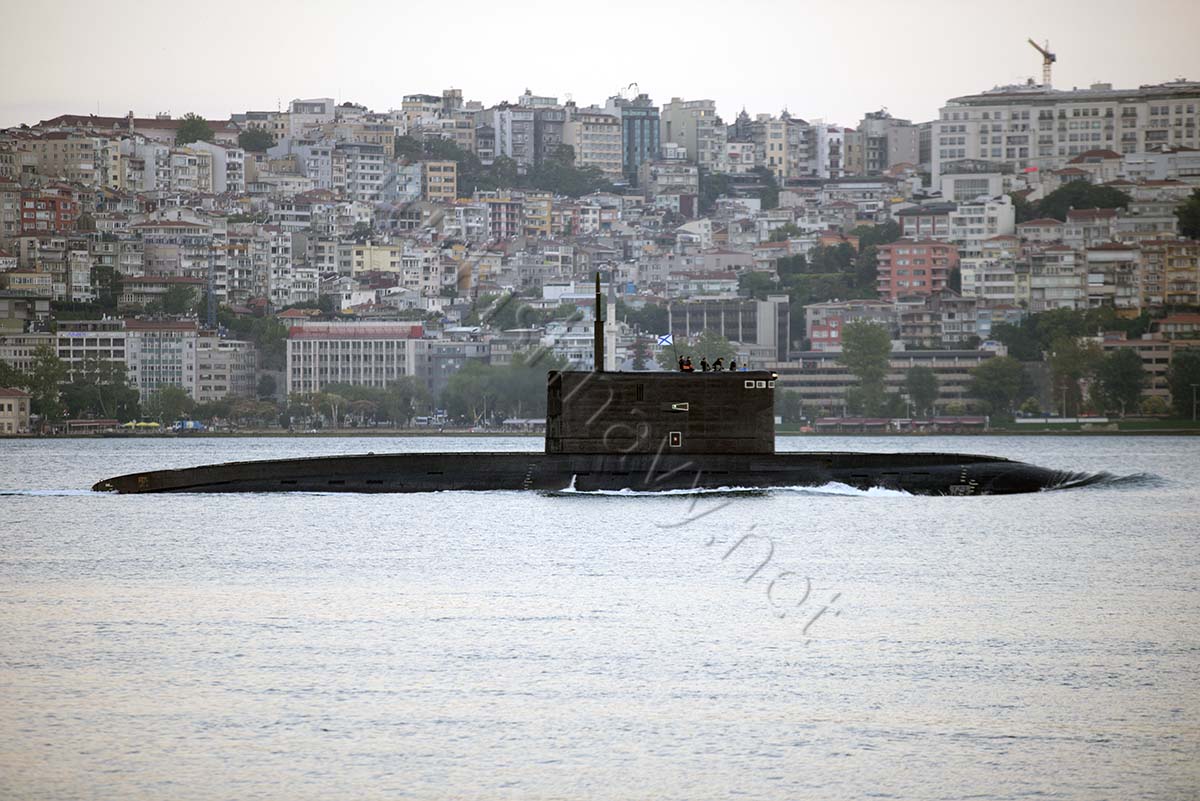 Like the Kilo class, the Improved Kilo-class has six 533mm torpedo tubes. The standard armament comprises a mixture of TEST-71ME, TEST-71/96 wire-guided ASW active and passive homing; Type 53-65 and SET-53 ASV passive wake homing; E53-56B acoustic homing torpedoes. One important addition to the arsenal of these submarines is the Kalibr class submarine-launched anti-ship and land attack cruise missiles.
As mentioned before, the Russian Navy units can carry and fire the Novator 3M-54 (SS-N-27 Sizzler) submarine-launched anti-ship missile and Novator 3M-14 (SS-N-30) submarine-launched land attack versions of the Kalibr family of missiles. Novator 3M-54 has a length of 8.22 meters with a 200 kg warhead and a range of up to 660 km. The Novator 3M-14 variant is 6.2 meters long, and this missile can deliver its 450 kg warhead up to a 2,500 km range.
Improved Kilo-class submarines in other navies can carry Novator 3M-54E missile variants. The 3M-54E missile is 8.2 meters long with a 200 kg warhead. They can deliver their payload up to 220 km with a speed of 2.9 Mach at the final stage. The 3M-54E1 variant is shorter at only 6.2 meters long with a payload of 200kg. The subsonic missile can travel up to 0.8 Mach with a 300 km range.
Both Kilo and Improved Kilo-class submarines have short-range shoulder-fired anti-air missiles, either SA-N-5 or SA-N-8 on board. Up to 8 missiles are stored in a well located at the fin.
One can argue that Kilo / Improved Kilo-class submarines are one of the best-selling diesel-electric submarines, with 58 units in service around the world and 10 units on order. When their design began, the aim was to export these submarines. The current spread of these vessels may have surpassed the imagination of its designers.
Epilogue:
I hope you have enjoyed reading my thoughts on the important naval developments for the last seven days. Read the previous instalments in the list below:
A Week of Reflection on the Pivotal Naval Moments of 2023: Day 1
A Week of Reflection on the Pivotal Naval Moments of 2023: Day 2
A Week of Reflection on the Pivotal Naval Moments of 2023: Day 3
A Week of Reflection on the Pivotal Naval Moments of 2023: Day 4
A Week of Reflection on the Pivotal Naval Moments of 2023: Day 5
A Week of Reflection on the Pivotal Naval Moments of 2023: Day 6


