
In this penultimate installation of my week-long exploration of the significant naval developments that shaped the maritime landscape from my point of view, we will look a little closer to the first of İstif class frigates TCG Istanbul.
The first indigenous frigate constructed in Turkey, TCG Istanbul is not commissioned yet, however, she was the lead ship of the 100-plus ship-strong naval parade held on 29 October 2023 to commemorate the 100th anniversary of the Turkish Republic.
TCG Istanbul will make the Turkish frigate force younger. The keel of the second frigate was laid on 15 November 2023 at Anadolu Shipyard. Turkey has bought second-hand frigates from the USA and bought MEKO 200-class frigates from Germany. Half of them were constructed in Turkey with German material help. All the know-how and expertise gained in these projects later showed themselves in the Ada class corvettes and Istif class frigate projects. In the last decade Turkish Naval TCG Anadolu, all of them were designed in Turkey too.
The contract for the construction of the TCG Istanbul, the lead ship of the Istif class frigates was signed between the SSB and STM the main contractor in April 2019.
These frigates have a full load displacement of 3,100 tonnes, a length of 113.2m, a beam of 14.4m, a draft of 4.05m, a top speed of 29 knots, and a standard range of 6,000 nautical miles at 12 knots, carrying a crew complement of 125. The main machinery of TCG Istanbul consists of one LM-2500 gas turbine and two MTU 4000 Series MTU 20V4000M93L diesel engines in CODAG configuration. The ships have two CP propellers. The following ships will have MAN Spain diesels as engines.
The main offensive weapons on board TCG Istanbul will be 16 Atmaca anti-ship missiles. Atmaca can be utilized in all weather conditions and is resistant to countermeasures, with target update, re-attack, and mission abort capabilities. Additionally, thanks to the advanced mission planning system (3D routing), it can be effective against fixed and moving targets. Equipped with a Global Positioning System (GPS), an Inertial Measurement Unit, Barometric Altimeter, and Radar Altimeter subsystems, Atmaca uses its active radar seeker to find its target with high accuracy.
With a range of over 220 km, Atmaca has an advanced and modern data link for its target update, re-attack, and mission abort capabilities. The system offers the most efficient mission profile and provides operation modes of timing, firing, and hitting the target. For defence against airborne threats, these frigates will be armed with Hisar-D and ESSM surface-to-air missiles. These missiles will be stored and launched from the National Vertical Launching System (MIDLAS).
When the project for construction started, it was envisaged to use the 16-cell Mk-41 VLS on the TCG Istanbul Frigate, and the SSB had assigned Roketsan to procure the Mk-41 VLS from the United States. On February 14, 2018, a contract was signed between the SSB and ROKETSAN for the procurement of 4 Vertical Launching Systems (VLS). However, after the acquisition of the S-400 Triumph Air Defense Missile System, the US Government imposed CAATSA sanctions on Türkiye, resulting in the non-fulfilment of the Mk-41 VLS procurement.
According to Defence Turkey Maganize, as a result, the decision to use MIDLAS, developed by Roketsan, on the ships was made. The 16-cell National Vertical Launching System (MIDLAS) was announced to allow the simultaneous use of both Hisar-D RF Block-II surface-to-air and ESSM (Evolved SeaSparrow Missile) B1 and B2 missiles. According to the Turkish Navy’s planning, MIDLAS can accommodate a total of 64 (16×4) ESSM Block 2 missiles or 16 Hisar missiles or a combination of ESSM Block 2 missiles in a quadpack configuration and HISAR missiles. As MIDLAS is a national launcher, the integration of ESSM requires an umbilical port (a connection system between the launcher and the missile). Roketsan had previously initiated efforts to develop an umbilical port-like system for ESSM integration with MIDLAS.
With a diameter of less than 250 mm and the quad-pack capability afforded by its folding fins and control surfaces, each MIDLAS cell can accommodate four HISAR-D RF Block-II G/Ms. Consequently, a total of 64 Hisar-D RF Block-II G/Ms can be housed in 16 MIDLAS cells, assuming there are no weight or budget constraints. The first test firing of the Hisar-D RF Block-II was conducted in December 2022. The main gun of TCG Istanbul is the Leonardo 76mm. The following ships will be fitted with the 76mm naval gun developed by MKE. For asymmetrical threats or close-in protection, there is one Gökdeniz turret on top of the hangar and two Aselsan 25mm Stop remote-controlled weapon stations.
The main search radar on board TCG Istanbul is the CENK-S, which features a rotating antenna and employs two-axis AESA technology. The radar is currently undergoing Sea Acceptance Tests (SAT) and is expected to be delivered to the TNFC on the TCG Istanbul Frigate at the end of 2023. The S-Band CENK-S 3D AESA Search Radar, which previously featured liquid cooling, weighs 1,700 kg and is said to include 4,000 GaN-based T/R modules. It has been stated that it will have an air/surface target detection capacity of over 1,000 and will offer double the range performance compared to the SMART-S Mk2 Radar.
TCG Istanbul is fitted with the Aselsan Ahtapot electro-optical reconnaissance, surveillance, and targeting system. The system has an IR camera, one full HDTV camera, one SWIR camera, and an eye-safe laser range finder. Ahtapot E/O system can illuminate targets with a laser, perform target geolocation, and automatic target detection. This system was first introduced on TCG Kınalıada, an Ada class frigate. Another important non-radio detection system on board TCG Istanbul is the Piri infra-red search and track system. One notable feature of Piri is the distributed sensor architecture, ensuring full azimuth coverage of 360° by strategically placing sensor units around the ship mast. This eliminates any blocked views, a significant advantage over rotating systems. The system can move in elevation, allowing for the detection and tracking of higher-altitude threats. This feature is complemented by accurate stabilization, definable masking zones, and video recording capability.
The Passive Search and Track system can detect and track multiple targets simultaneously, thanks to staring sensors that offer a very high image update rate compared to rotating systems. This results in a shorter time for track declaration, a longer track declaration range, and an extended available time for countermeasures. The simultaneous dual-band IR imaging minimizes false alarms, while the large elevation FOV enables the simultaneous detection of sea-skimming missiles and higher-altitude airborne targets.
For electronic warfare, there are two different systems. For electronic countermeasures (ECM), the Aselsan-made AREAS-2NC is used. The system is designed for electronic attack missions on surface platforms. The system can internally generate ECM techniques, which can be applied either separately or simultaneously. It is programmable via a mission data file and can also seamlessly integrate with the combat management system.
The distinctive shape of the Aselsan ARE2N ESM system is a prominent feature of the main mast. ARES-2N is designed for intercepting, detecting, and identifying radar signals with precise parameter measurement and accurate direction finding. It characterizes advanced emitters and automatically identifies them via the mission data file. The system features a wide-band microwave receiver architecture, a high-gain antenna array, and employs the amplitude comparison method for direction finding according to Aselsan.
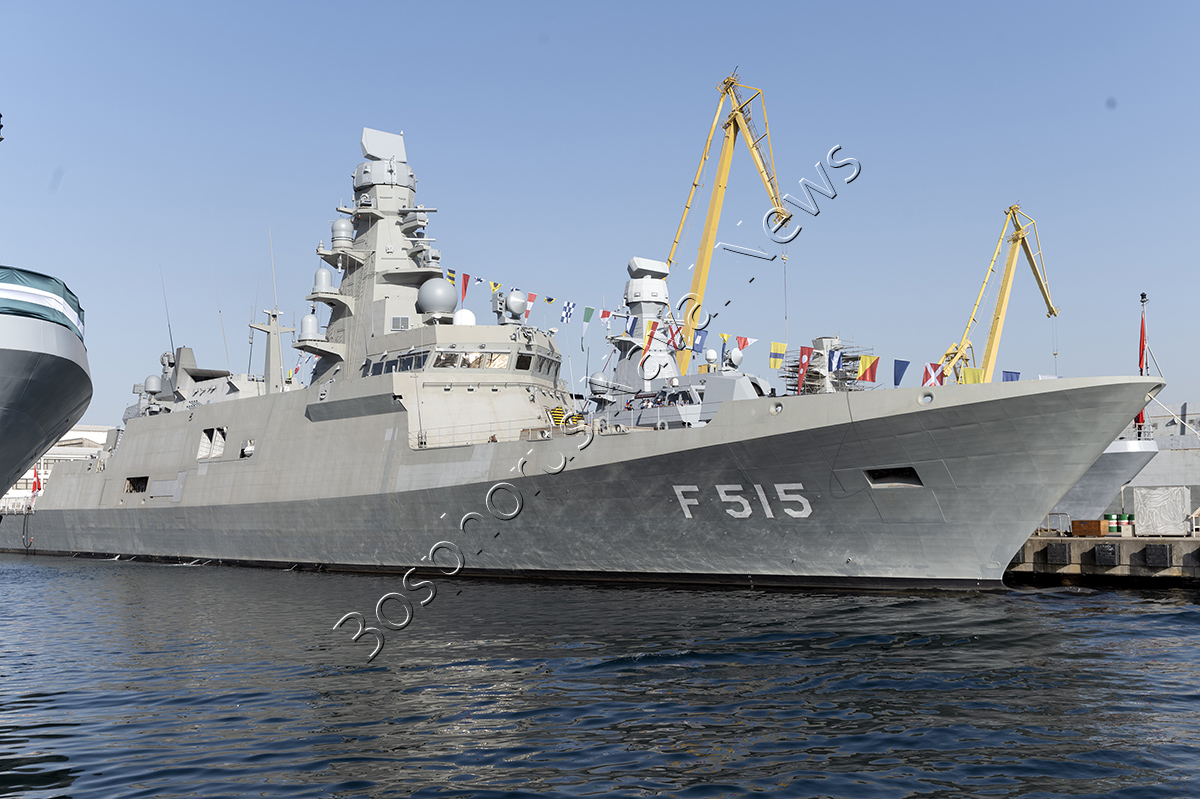
In January 2023, STM the main contractor of the İstif class frigates signed a deal with 3 Turkish shipyards for the construction of the follow-on ships, Izmir, Izmit, and Içel, in January 2023. The next three frigates will be constructed simultaneously in the Anadolu, Sedef, and Sefine shipyards. This method will be tried for the first time in Turkey. It will speed up the delivery of the ships but will also certainly create problems regarding project and quality management.
In April 2023 the construction of these three new frigates started. The STM will transfer military shipbuilding experience and technologies learned during the
construction of the Ada class corvettes, Ukrainian Corvette Project, and projects in Pakistan, to the 6th, 7th, and 8th ships in the program. STM will deliver The sister vessels, within 36 months.


Couldn’t see any info about the ASW capabilities of Istanbul/Istif Class ships.
I will add information about ASW capabilities in the future in a separate post.