The Russian Invasion of Ukraine has brought one of the oldest and maybe one of the most potent and silent killers of the seas back to our daily lives: the sea mines.
The first floating mine near Istanbul was spotted on 26 March 2022 by a merchant ship at anchor near the northern entrance of Bosphorus waiting for her turn to pass through the strait. The Turkish Navy EOD team, whose HQ is not far away from this location were immediately dispatched. The mine was secured and towed to a naval special forces exercise area again near the incident site. In this area where public access is restricted the EOD teams destroyed the mine.
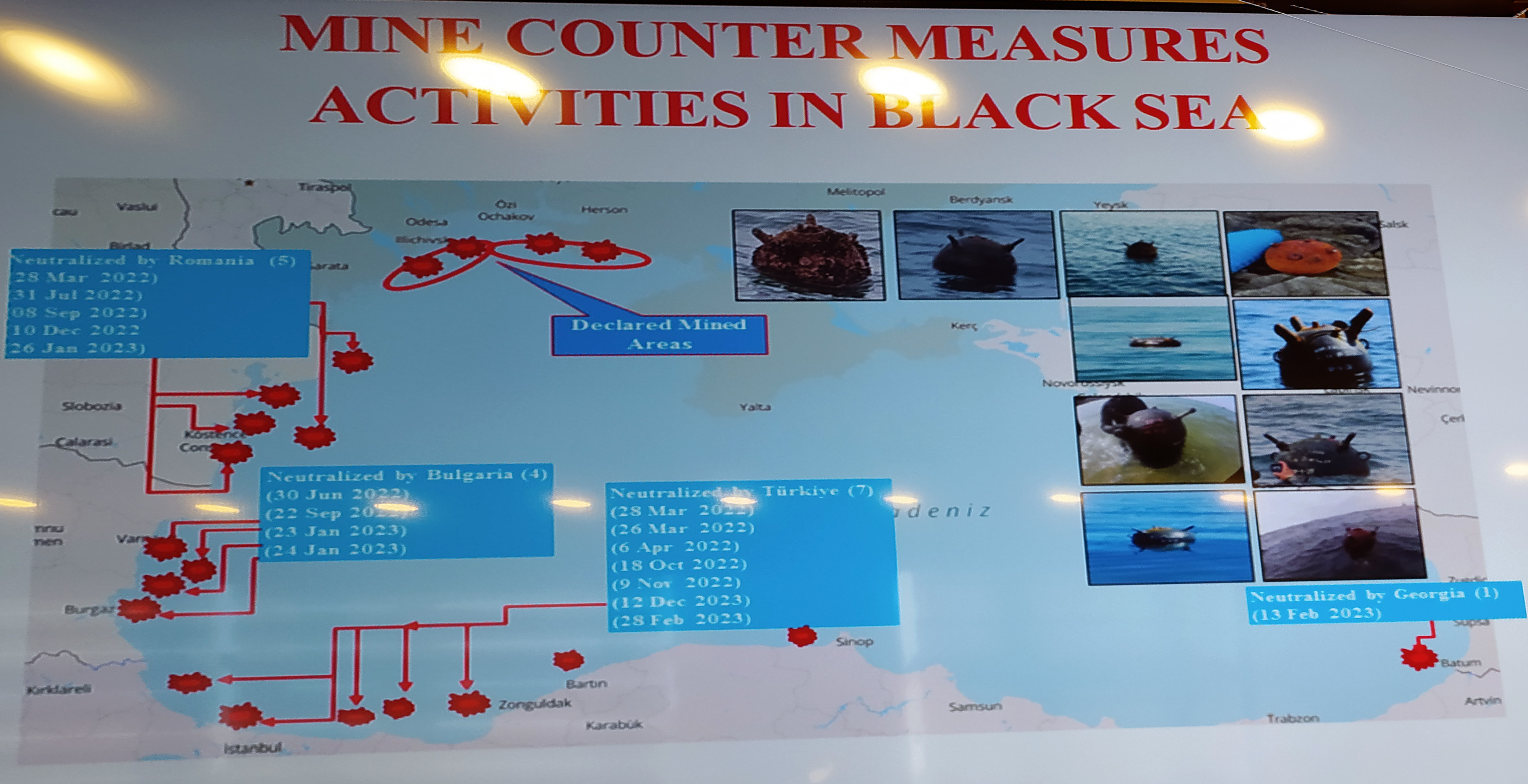
This was the first of many mine sightings and neutralisations for the months to come. According to a press release made by Turkish Naval Forces in early 2023, Turkish Naval ships performed 6747 hours of the cruise by patrol vessels and mine countermeasures ships in 2022. Furthermore, manned and unmanned Turkish Naval aviation units spend 1496 hours in the air to detect mines drifting in the Black Sea.
Turkey, Bulgaria and Romania together can gather 23 mine sweepers and hunters to counter any naval mines in the Black Sea.
Turkey has 6 Aydın class – based on the German Type 332 class- and 5 Engin ex-French Circe class mines hunters. Bulgaria operates 3 Tripartite class mine hunters – one bought from Belgium two from the Netherlands and 3 Priz class mine sweepers – transferred from the USSR.
Romania acquired two retired Royal Navy minehunters HMS Blyth and HMS Pembroke in 2022. The former Sandown Class ships are 52.5m long, weigh 485 tonnes and have a range of more than 2,500 nautical miles without refuelling. This is a welcomed addition to the existing Romanian MCM forces. With the advent of these new mine hunters, The Romanian navy will have a true mine-hunting capability for the first time. The first one, ROS Sub-Lieutenant Ion Ghiculescu passed northbound through Istanbul on 18 December 2023 and is her homeport, Constanta.
All the other existing mine countermeasures warships in the Romanian Naval Service are from the Warshaw Pact times and are equipped with minesweeping equipment. These 4 Musca class minesweepers were commissioned between 1987 and 1989. They are 59.2m long and weigh 800 tons fully loaded. The Romanian Naval Forces also use one Corsar class minelayer and one modified Project 1395 ice-going rescue and salvage ship to support MCM operations and smaller MCM ships.
The new two minehunters taken over from the British Royal Navy will be upgraded and equipped with high-definition sonar for submarine research and mine search, as well as the SeaFox system to neutralize mines remotely, through the use of remote-controlled underwater drones, which are capable of moving to different submerged locations, via an integrated orientation sonar.
The mine countermeasure warfare capability of the Bulgarian Naval forces is slightly better than their northern neighbour. They bought their first modern mine hunter, a Tripartite class ex-BNS Myosotis from the Belgian Navy in 2009. Two more warships of the same class were purchased from the Netherlands in 2020. These ships have hull mounted mine hunting sonars and the Dutch ones have also variable depth sonars. They can also carry PAP-104 or Atlas SeaFox remote-controlled mine locators.
In addition to these mine hunters Bulgarian Navy operates three Sonya class minesweepers transferred from the USSR in 1981 and 1984 and six Olya class inshore minesweepers.
With 11 mine hunters in operation, it seems that the Turkish Naval Forces will undertake most of the burden in the mine task force formed by the three countries. Turkey bought 5 Engin class minehunters from France in 1997. These ships are 50.9 meters long and weigh 510 tons fully loaded. They have hull-mounted mine detection sonars and carry PAP Plus mine locators. The newer generation of mine hunters in the Turkish Navy are the Aydın class warships, derivate from the German Type 332. Aydın class MCM ships are 54.5 meters long and have a displacement of 657 tons. They carry one variable dept sonar on board and can deploy 2 PAP 104 Mk5 mine locators.
These ships have additional mechanical sweeps too.
Other important assets Turkey’s Armed Forces deploy when countering mines in the Black Sea are the manned and unmanned aeroplanes. The unnamed one can carry Meteksan SAR radar which can see the drifting mine on the water surface far better and from much distance than the naked eye.
To effectively combat the mine menace in the Black Sea Turkey, Bulgaria and Romania are planning to combine their forces. On 11 October 2023, the Turkish Ministry Of Defence announced that the Minister of National Defense Yaşar Güler met with Bulgarian Minister of Defense Todor Tagarev and Romanian Deputy Minister of
Defense Simona Cojocaru at NATO Headquarters, where he was present within the scope of the NATO Defense Ministers Meeting. At the meeting, it was decided to establish a “tripartite initiative” to work together in the fight against sea mines in the Black Sea.
during a press meeting on 17 December 2023, Minister Güler said that Turkey, Romania and Bulgaria came together and decided to establish a Mine Countermeasures Cooperation. The aim here is to detect mines drifting from both Russian and Ukrainian ports and destroy them before they reach our shores. We have destroyed the mines as soon as we detected them. We carry out mine detection studies in the Black Sea with our maritime patrol planes and ships. When we started receiving more mines lately, we established such a tripartite structure. Our minehunters will constantly patrol until the Romanian-Ukrainian border.
It is important for these three states to have a functional HQ and allocated forces ready to combat the mine menace in the Black Sea. All three nations have been trying to detect and neutralize drifting mines by their own means since the start of the Russian invasion of Ukraine. Pooling their knowledge and sources together will definitely help ease their plight.
One day the war between Russia and Ukraine will end. However, the sea mines both parties have put in the Black Sea will keep posing a serious danger to the navigation of merchant ships.

 devrimyaylali.com