The Russian invasion of Ukraine demonstrated again that nations need to invest regularly in their navies. It is not cheap or simple to build and maintain a navy and keep it up-to-date against contemporary threads.
Today we are going to briefly examine the new warship construction or acquisition projects of the Black Sea countries.
For Bulgaria, a significant milestone was achieved at the MTG Dolphin JSC Shipyard in Varna on 3rd December 2021 as the first steel for two new Multipurpose Modular Patrol Vessels (MMVP) was cut during a ceremonial event. This development marked a crucial step in Bulgaria’s efforts to procure modern surface combatants that align with NATO requirements, addressing the need to replace outdated Pauk (Project 1241P) and Tarantul (Project 1241.1M) class corvettes acquired from the USSR. These ageing vessels, now obsolete and costly to maintain, are to be succeeded by the MMVPs, which are approximately 90 meters long, with a displacement of around 2,300 tons. While specific details regarding armament and sensors remain undisclosed, the vessels are based on the proven OPV 90 design from the NVL portfolio and incorporate an integrated Combat Management System, with SAAB announced as the provider.
The MMVPs are set to be armed with a 76mm main gun, an 8-cell VLS for MBDA VL MICA SAM, two twin launchers for SAAB RBS15 Mk3 SSM, a Rheinmetall Oerlikon MILLENIUM GUN 35mm CIWS and two 324mm torpedo launching systems. Notably, these vessels will introduce a flight deck and hangar to the Bulgarian Naval forces, enabling the accommodation of the AS-565MB Panther naval helicopter. The project, valued at approximately 420 million euros, holds immense significance for Bulgaria’s naval capabilities, providing the nation with the means to fulfil its constitutional obligations and stand as an equal member in alliances. Rear Admiral Kiril Mihailov, Commander of the Bulgarian Naval Forces, expressed his satisfaction during the keel laying ceremony, stating that the realization of new warships after more than 15 years of anticipation is about to become a reality. The delivery of the first vessel is scheduled for the third quarter of 2025, with the second vessel following a year later.
On August 4, 2023, the MTG Dolphin Shipyard PLC in Varna achieved another milestone by launching the first of the two new 2,300-ton MMPVs, The vessels are expected to renew Bulgaria’s naval capabilities and contribute significantly to NATO’s naval forces in the Black Sea. Armed with an array of advanced weaponry, the MMPVs represent a substantial leap in Bulgaria’s naval modernization efforts.
So 2023 was a good year for the Bulgarian naval armament programs but more is needed.
For Romania 2023 was not a good year as the Romanian Ministry of Defence ended the contract negotiations with the Naval Group of France and decided not to proceed with Damen of the Netherlands instead.
In the middle of the last decade, Romania formulated a request for four multipurpose corvette-type warships with a displacement between 2000 – 2500 tons. These warships should be able to conduct anti-surface, anti-submarine and anti-air warfare and they must be equipped with the necessary weapon and sensor systems. The estimated value of the projected four corvettes was approximately 1.6 Billion Euros according to the official documents. The total cost includes the acquisition of ammunition, initial logistic support, crew training, and offset agreements.
In 2019 the Romanian Ministry of Defence declared the Naval Group and SC Constanta Naval Shipyard SA joint venture as the winner of the Multipurpose Corvette program after a yearlong tender process. The French company would supply 4 Gowind 2500 corvettes with diesel-electric hybrid propulsion and European armament solutions with MBDA VL MICA surface-to-air missiles and Exocet MM40 Block 3 anti-ship missiles for a contract of EUR 1.2 billion.
According to the Romanian MoD, they and the winning consortium had an unfruitful discussion between 2019 and 2023, forcing the Romanian side to terminate the negotiation. The reason for the Naval Group and its Romanian partner to refuse to sign a contract with the Romanian MoD is believed to be the inability of the winning party to fulfil its obligations due to cost increases. The decision by the Romanian MoD not to negotiate with the second bidder is also a sign that budgetary constraints are an important factor. They have however clearly stated during the same announcement that informed the end of negotiations with the Naval Group, that Romania intends to remain part of a European program within PESCO for the development of a European model of multifunctional corvette Modular and Multirole Patrol Corvette. The first ships of this project are expected to be commissioned after 2030.
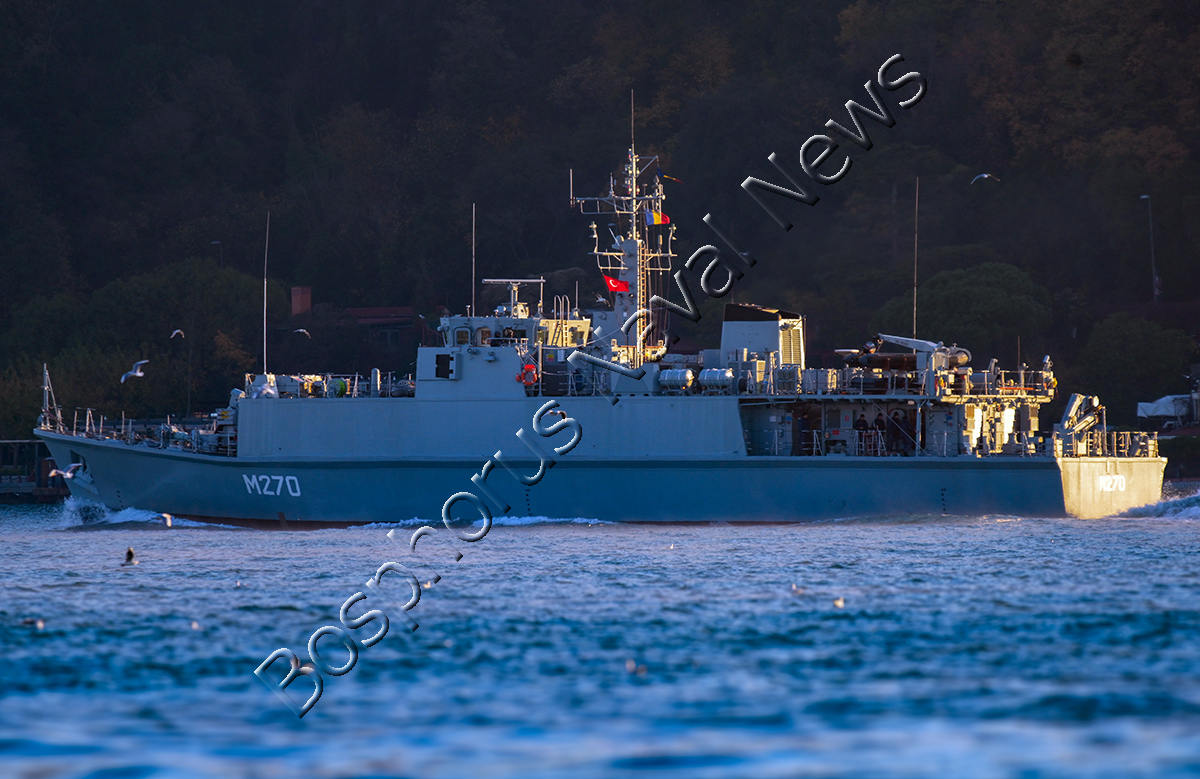
However, shortly before the end of the year first of the two new mine hunters bought from the Royal Navy made her inaugural passage through the Turkish Straits.
It was the last important waypoint of over 4.500 nautical mile long journey, starting in mid-November from the Babcock shipyard in the Scottish port of Rosyth and ending on 19 December 2023 in Constanta. Commanded by Lieutenant Commander Denis Giubernea, this minehunter, formerly known as HMS Blyth in the British Royal Navy, boasts a crew of 40 skilled sailors and will be part of the 146th Mine-Demining Ships Battalion.
The Romanian Naval Forces perform operations to monitor maritime traffic, ensuring security at the river border in the north of the Danube Delta.
Acquired through a government-to-government agreement with a value of 150 million Euros with the UK, the ROS Ghiculescu is the first of the two Sandown class minehunters. They will play a crucial role in identifying and neutralizing drifting mines in the Black Sea, contributing significantly to stability in the Pontic basin. ROS Ghiculescu will be an important contributor to the trilateral naval mine operation in the Black Sea (MCM Black Sea) launched by Turkey, Romania, and Bulgaria.
It is difficult to keep track of the warships and boats of a navy engaged in a shooting war. Ukraine however got some new naval vessels delivered. In November 2019 Ukraine, a framework agreement between the governments of Ukraine and France to support maritime security and protection was signed. A contract for the contract for the construction of 20 OCEA FPB 98 boats for the Maritime Guard of Ukraine followed in July 2020. The first boat was launched in December 2021 and the second one in February 2022. Originally the first pair was scheduled to be delivered in the second quarter of 2022, with all 20 to be handed over by 2024. However, the Russian invasion of Ukraine in February 2022 and the consequent closure of the Turkish Straits to foreign warships changed everything.
The Turkish ship spotters in Istanbul noticed that one Antigua and Barbuda-flagged merchant vessel transited through Istanbul northbound in the early morning hours on 23 May 2023 with two FPB 98 on board. The patrol boats spotted on a merchant vessel were unarmed and all the markings indicating these boats belonged to the Ukrainian Border Guard were covered to hide the true identity of these boats.
The boat measures 31.8 meters in length, and 6.3 meters in width, and has a draft of 1.15 meters, with a displacement of approximately 100 tons making it well-suited for coastal operations. Equipped with powerful engines, it can reach speeds of up to 35 knots (65 km/h), ensuring rapid response and effective interception capabilities. The patrol boats have a cruising range of 1,200 nautical miles at 12.
Another Ukrainian new procurement was a Turkish MRTP-16 boat. Erdem Yılmaztürk, Vice Chairman of the Board of Directors of Yonca Teknik Shipyard, a Shipyard specialised in producing high-speed patrol boats, announced in an interview on September 6 that they delivered the Ukraine project. However, he did not share any information about the number of boats produced or the type of boats. Yonca Shipyard also lists Ukrainian MoD among its clients.
In light of the Ukrainian Naval Forces’ priorities and the budgetary constraints the country is facing it is safe to assume that the production might have covered a very limited number of boats as low as one or two. The only photo of the boat shared on social media clearly shows the boat is of MRTP-16 class.

The boat is painted all black and at the time when it was photographed it bear no markings or flags. However, the unique design of the boat helps with the identification. The boat is only armed with one machine gun, mounted on a mechanical mount. The gun is operated manually.
The MRTP-16 has been designed to carry out a wide range of littoral and coastal water law enforcement and naval duties, such as search and rescue, anti-smuggling, pollution control, surveillance, patrol and special forces insertion and extraction. In Ukrainian service, the boat will likely be used for military operations rather than constabulary missions.
According to the shipyard Turkish and NATO naval standards have been applied for the intact and damaged stability when designing the MRTP-16 boats. The vessels meet the Turkish Navy and NATO criteria for damaged stability and will remain afloat and upright with flooding in any single main compartment.
The MRTP-16 boats are 17,75 meters long and 4,19 meters wide. Their draught is 1,30 meters when still 0,90 meters when at speed. They have approximately 20 tons of displacement. They can reach up to 75+ knots of speed depending on the engine and drive system.
Of course, the most talked about new warships of Ukraine are the two minehunters the UK donated Sandown minehunters. The ships are two former HMS Grimsby and HMS Shoreham. They are renamed Chernihiv and Cherkasy respectively. The ships were handed over to the Ukrainian Navy in the UK in July. They have already taken part in several military exercises. Their passage to the Black Sea has created quite a controversy.
In conclusion, all three smaller Black Sea navies have stepped up their investment and have new acquisition projects in place. However, in the case of Ukraine, it is too late and too few, in the case of Romania it needs to be managed both politically and financially much much better and in the case of Bulgaria follow-up projects to rejuvenate the fleet is very much needed.

 devrimyaylali.com