Yesterday, when I was writing about the lessons to be learned from the war in the Black Sea, I did not mention the use of expandable USV in detail, as I intend to do that today.
Ukraine faced a formidable challenge in reshaping the maritime dynamics of the Black Sea conflict. Illustrating its ability to disrupt Russian naval dominance, Ukraine strategically deployed Neptune anti-ship missiles, sinking the Moskva missile cruiser. An additional potent weapon in Ukraine’s arsenal emerged in the form of unmanned surface vessels (USVs) laden with explosives, proving instrumental in challenging the Russian Naval Forces.
In a significant turn of events, Ukraine orchestrated two impactful USV attacks in August, underscoring the vulnerabilities within the Russian Black Sea Fleet. The first strike targeted the Ropucha-class landing ship, Olenegorskiy Gornyk, near Novorossiysk, causing substantial damage. The second USV attack aimed at a Russian-flagged tanker, Sig, in the Kerch Strait, further disrupting crucial maritime operations for Russia.
The Ukrainian USV believed to be used in the attack is Magura V5. The vessel is 5,5 meters long and 1,5 meters wide. It has a cruising speed of 22 knots and a maximum speed of 42 knots. It is range is 450 nautical miles. This can be altered by adding or removing fuel and the explosives for the warhead. The USV can carry around 300 kilograms of explosives.
The attack on the Ropcuha class landing ship was important because Novorossiysk is approximately 362 nautical miles away from Odessa. This is a very long distance for a small unmanned kamikaze vessel to travel alone.
Two other attacks on two different Russian intelligence-gathering ships were also reported by Russia in the Summer of 2023. However, these attacks were thwarted by the vessels and they were able to return home safely.
Ukraine is not the only nation interested in kamikaze surface vessels in the Black Sea. During the 16th iteration of the IDEF Defence Exhibition, organised in Istanbul, three Turkish companies introduced their exposable unmanned surface vessels to the audience.
The joint venture of Ares Shipyard and Meteksan Defence was the first to unveil their expendable vessel Ulaq Kama. The semi-submersible vessel is 6,37 meters long and 1,20 meters wide. It has only 30 centimetres of draft. The vessel has a 200+ nautical miles range at 20+ knots of economical speed. The maximum speed is 50 knots. The 1300-kilogram vessel carries 200 kilograms of payload. According to the press release, Ulaq Kama is not only a deterrent weapon with its explosive payload but also serves as an Intelligence, Surveillance, and Reconnaissance (ISR) platform thanks to its uninterruptible communication network, long-range, very low silhouette and unique seaworthiness beyond its dimensions.
While the company did not comment about the satellite communications on board. However, the computer-created graphics depict a fast boat with an antenna very similar to a Starlink antenna. Starlink has not obtained a licence from the Turkish Government to provide internet service in Turkey therefore does not offer service in Turkey but it is widely and successfully used by the Ukrainian Armed Forces for communication and for command and control of unmanned surface vessels.
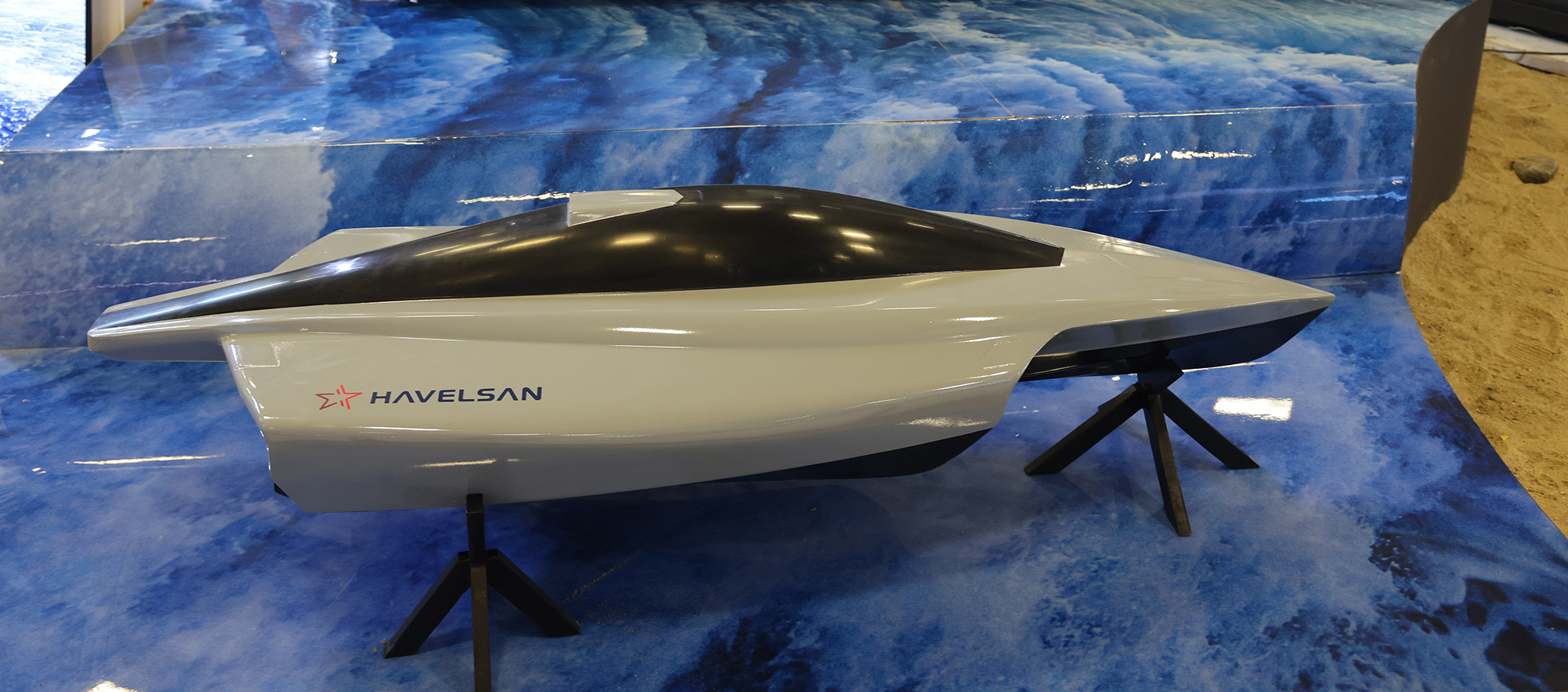
Another company that showed a disposable unmanned surface vessel was Havelsan. The company debuted their Çaka S-KUSV exposable unmanned vessel. S-KUSV stands for Submersible Kamikaze Unmanned Surface Vehicle. The Çaka S-KUSV has trimaran hull form. Its unique design allows for stealthy, powerful strikes against surface targets, enhancing naval capabilities in A2AD missions. It can submerge to avoid detection for a period of up to 40- 48 hours. It is 8,5 meters long and 3,3 meters wide. It will have a displacement of around 3,2 tons. The vessel will have a diesel engine and a water jet propulsion for surface transit and two electric motors and propellers for underwater transit.
According to the Havelsan press release the Çaka S-KUSV is equipped with high-explosive payloads, ensuring a powerful impact on its targets. Its ability to operate underwater adds an element of surprise, allowing it to catch adversaries off-guard and deliver superior strikes. The vessel will have a high degree of autonomy for underwater operations and have satellite and data link connections for command control and updates.
Aselsan was the third company that debuted a disposable unmanned surface vessel. The Albatros Kamikaze is 7.2 meters long and 2 meters wide. It has a displacement of 2200 kilograms. The diesel engine on board can propel the vessel at more than 40 knots. The vessel can carry a 200+ kilogram warhead.
Aselsan has been developing USV for a couple years. First, they have made Albatros targeting drones for gunnery and target tracking exercises. Later with Sefine shipyard Aselsan produced the Marlin USV. This vessel took part in REPMUS 22 and Dynamic Messenger 22 exercises organised by NATO and held at the Maritime Operational Experimentation Center (CEOM) in Troia, Portugal.
The capabilities of Albatros Kamikaze were put to a show in early October when the Turkish Navy in cooperation with Aselsan conducted a sinking exercise off the coast of the Mediterranean town Taşucu near Mersin. The most important feature that differentiated this sinking exercise from others was the fact that there was minimal human interference during the whole exercise. The target was a stationary 22-meter-long hulk of a civilian vessel detected by a Bayraktar TB-2 UAV. The target information was forwarded to three Albatros Kamizkaze USVs.
The Albatros Kamikaze USV boasts an impressive capacity for engaging targets with precision and impact. Its sophisticated AI-driven systems identify and respond to potential threats swiftly and decisively. The USV can execute diverse tasks either alone or as a swarm. The swarm can perform different tasks, including asymmetrical strikes by approaching the target with various manoeuvres from different sectors, to avoid moving and stationary obstacles, and to continue the task even though some units in the swarm became inoperable due to enemy action.
Some of these features were tested during the recent exercise. One of the three USVs sailing as a swarm continued towards the target vessel while the remaining two broke contact. The disposable USV hit the target vessel and detonated. The explosion created enough damage to sink the target.
The exercise was watched live by the Naval Forces Commander Admiral Ercüment Tatlıoğlu, Presidential Defense Industry President Haluk Görgün, ASELSAN General Manager Ahmet Akyol and other officials at the Naval Forces Command Headquarters in Ankara.
Using disposable unmanned surface vessels to sink or damage enemy vessels is not something new. However, this was the very first time that Turkish Naval Forces performed a similar activity using Turkish-made weapons and vessels. Turkey’s contributions to the field of expendable USVs signal a significant shift in naval warfare dynamics. As the development and deployment of these advanced USVs progress, the naval landscape stands poised for transformation, ushering in a new era of strategic possibilities and heightened security.
In conclusion, the successful deployment of these weapons not only showcased Ukraine’s ability to disrupt Russian naval dominance but also highlighted the vulnerabilities within the Russian Black Sea Fleet. The impactful USV attacks in August, targeting the Ropucha-class landing ship and a Russian-flagged tanker, demonstrated the effectiveness of this unconventional warfare tactic. The specific details of the Ukrainian USV, the Magura V5, with its impressive speed, range, and payload capacity, underscore the nation’s commitment to leveraging cutting-edge technology for maritime defence.
Furthermore, the article highlights that Ukraine is not alone in exploring the potential of expendable USVs in the Black Sea. During the IDEF Defence Exhibition, Turkish companies unveiled their own versions of these vessels, such as the Ulaq Kama, Çaka S-KUSV, and Albatros Kamikaze. These USVs are not only equipped with explosive payloads but also serve as Intelligence, Surveillance, and Reconnaissance (ISR) platforms, adding a multifaceted dimension to naval capabilities. The Turkish Navy’s successful sinking exercise with the Albatros Kamikaze USV signals a significant milestone, showcasing the potential of these vessels in naval warfare. As other nations invest in and deploy similar advanced USVs, the landscape of naval warfare is set to undergo a transformative shift, introducing new strategic possibilities and heightened security measures in the Black Sea and beyond.

 devrimyaylali.com